★★★★★
“Allen provided exceptional service — friendly, professional and went above and beyond.”
JVerified
Jane
Wantirna South, VIC

FreshDuct cleans and services freestanding wood heaters across Melbourne. Every part of the system is reachable on a freestanding unit, which means there is no excuse for a service that only does half of it.
Flue running exposed through the ceiling? The whole system can be inspected. Insist that it is.
A freestanding wood heater sits on a hearth in the room with its flue running visibly up through the ceiling and out the roof. It is the most common wood heating configuration in Melbourne’s outer suburbs and semi-rural fringe, largely because it can be installed in a house that never had a chimney, and it is the configuration we most enjoy servicing.
The reason is access. On an inbuilt or built-in appliance, the flue connection, the seals and the cavity behind are concealed and inspecting them means removing a fascia or, sometimes, accepting that they cannot be inspected at all. On a freestanding unit every component of the system is reachable: the appliance from all sides, the flue from the spigot to the terminal, the ceiling penetration, the roof flashing and the cowl.
That accessibility should raise the standard rather than lower the price. A freestanding heater service ought to cover the full flue length and its joints, the ceiling penetration and its guard, the roof flashing and termination height, the clearances from the appliance and the flue to every combustible surface nearby, the hearth extent, and the complete appliance strip-down. None of it is difficult to reach.
In practice, plenty of freestanding heater services consist of a brush pushed a couple of metres up the flue from the room. That is not a service, and on an appliance where the whole system is genuinely accessible it is a strange thing to accept. We do the full run, we go on the roof where it is safe, and we photograph the parts of the system you cannot see from the living room.
Everything reachable on a freestanding installation, which is all of it.
The full system, because on this configuration all of it is reachable.
Sectional flue systems rely on every length being fully seated and secured. Thermal cycling can work a joint loose over years, and a separated joint is a flue-gas leak into a ceiling or roof space that is invisible from the room. We sweep the full run and check the joints as we go rather than stopping at arm’s reach.
Where the flue passes through the ceiling it needs the correct guard and air gap, and where it exits the roof the flashing has to keep water out. Both are common failure points and both are accessible on this configuration. We check and photograph them as part of every service.
The distance from the appliance body and the flue to timber framing, plasterboard, a mantel, joinery or a nearby wall is the most safety-critical measurement in the installation. On a freestanding unit it can be measured directly. We do, and we photograph anything that looks tight or shows heat discolouration.
The hearth needs to extend far enough in front of and around the appliance to catch embers and protect the floor beneath. Undersized hearths, particularly over timber floors, are something we see regularly and always report. It is a cheap thing to correct and an expensive thing to ignore.
Baffle out and inspected, secondary air passages cleared, firebricks checked, airwash channels opened, ash and clinker removed, door rope tested and replaced where needed, glass and retainers checked, and the ash pan and grate cleared where fitted.
FreshDuct recommends an annual sweep and full service before the season. Because everything is accessible on a freestanding unit, an annual service is genuinely comprehensive rather than a partial look at whatever could be reached.
Real FreshDuct flue and roof photography from Melbourne jobs, documented on every visit.
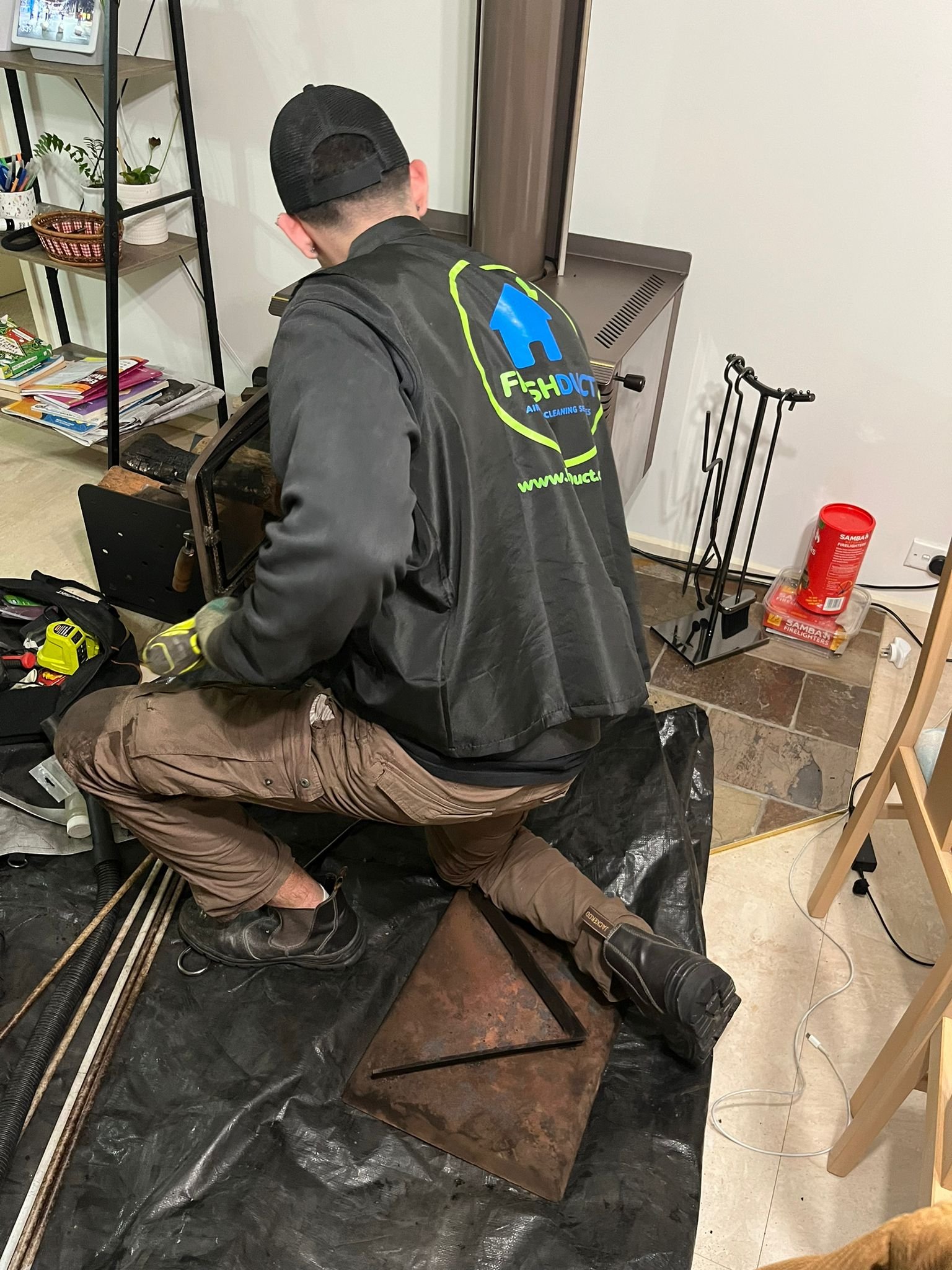

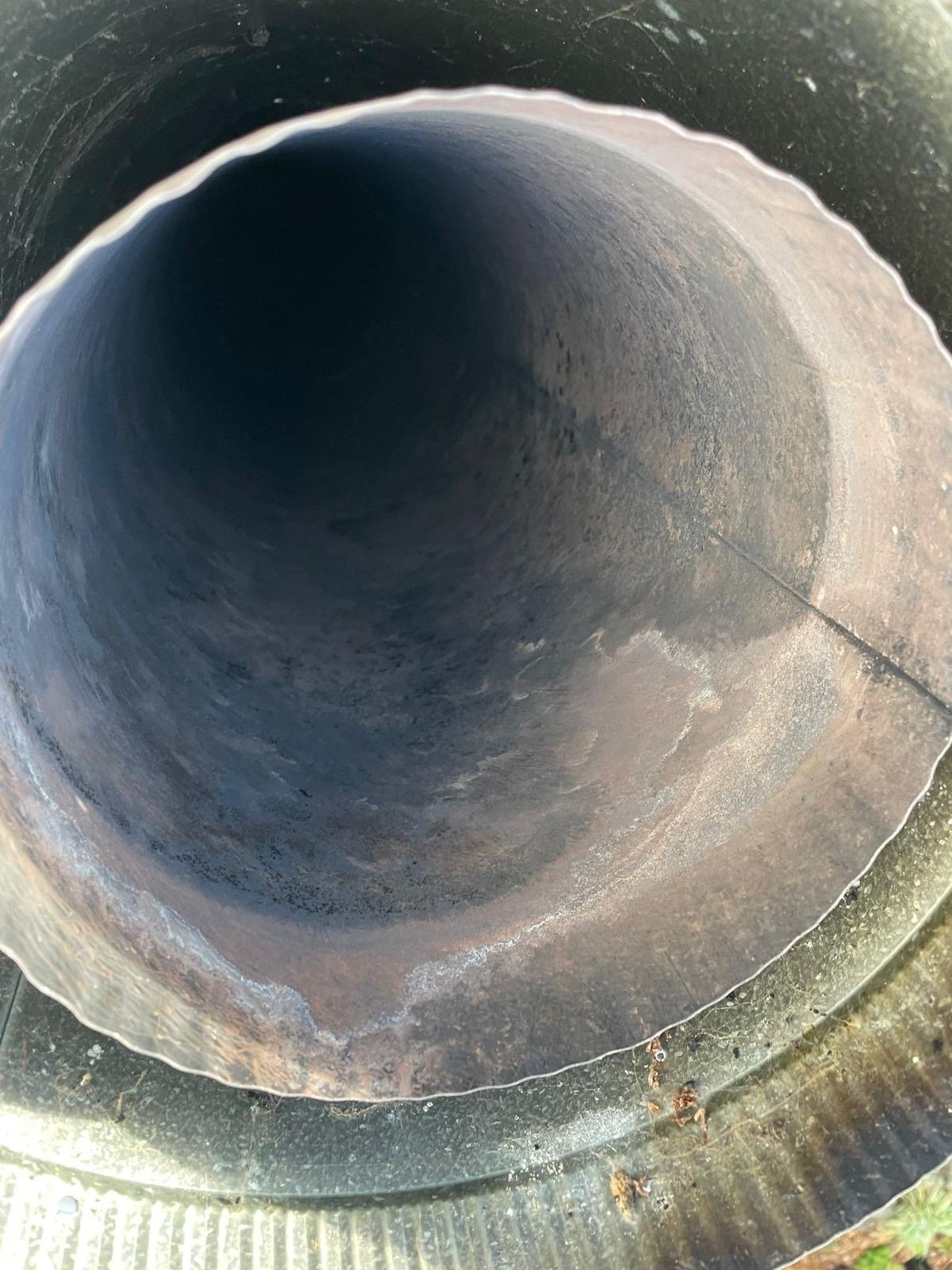
We sweep the flue from the appliance spigot to the terminal, check every joint, strip and service the firebox completely, and inspect the ceiling penetration, roof flashing, termination height and cowl from the roof where access is safe. Clearances and hearth extent are measured and photographed.
You get images of the parts of your system you have never seen — the inside of the flue, the ceiling penetration from above, the termination on the roof — along with a written note on anything that concerned us. Where rectification work is needed to meet installation requirements, we refer it to a suitably qualified installer rather than pretending to certify it ourselves.
Book a Freestanding Heater ServiceWe service freestanding wood heaters throughout Melbourne, most heavily in the outer suburbs and semi-rural fringe where they are the dominant configuration: Eltham, Warrandyte, Greensborough, Ringwood, Croydon, Lilydale, Healesville, the Dandenong Ranges, the Yarra Valley and the Macedon Ranges.
They are also common in growth-corridor homes through Craigieburn, Melton, Pakenham, Berwick and Cranbourne, where a heater was added to a house built without a chimney. Those newer installations are frequently the ones where the flue was assembled by someone other than a heating specialist, which is exactly why we check the joints, the penetration and the termination rather than assuming them.
Everything is reachable, so everything gets checked.
Flue route, clearances, hearth and termination noted first.
Floor and hearth covered, extraction running before we open up.
Spigot to terminal, with joints checked along the whole length.
Baffle, air passages, bricks, ash pan and grate all dealt with.
Flashing, termination height and cowl inspected where access is safe.
Images of the flue interior, penetration and roof, plus a written note.
Verified 5-star reviews from across FreshDuct’s chimney, fireplace, duct, heating and insulation services. These are company-wide reviews from our Melbourne customer base — not reviews of any particular appliance brand.
“Allen provided exceptional service — friendly, professional and went above and beyond.”
“Highly impressed with the professionalism and efficiency. On time, and no mess left behind.”
“Exceeded my expectations. Knowledgeable, meticulous and respectful of our home.”
“So glad I chose FreshDuct. Knowledgeable team and the whole process was smooth from start to finish.”
“Quick, efficient and professional — we could immediately feel the difference.”
“The technician arrived on time and was incredibly thorough — the difference at home is obvious.”
What freestanding installations most often need.
All of it, from the appliance spigot to the terminal. On a freestanding installation the entire run is accessible, so there is no legitimate reason to sweep only the first metre or two. If a service did not cover the full length and check the joints, most of the flue was not inspected.
Because the termination height, the flashing and the cowl are all up there and all matter. A flue that stops too low causes persistent downdraught, failed flashing lets water into the roof space, and a blocked or damaged cowl restricts the flue. None of it can be assessed from inside the room.
That depends on the specific appliance and its installation instructions, which set the required distances to combustible surfaces. We measure what is actually there and photograph anything that looks tight or shows heat discolouration. We are a service company rather than a certifier, so rectification is referred to a qualified installer.
An air gap around the flue at the ceiling penetration is normal and intentional, but it should be formed by a proper guard rather than simply be a hole. We check that the penetration has the correct arrangement and photograph it, because it is one of the more common things a non-specialist installation gets wrong.
FreshDuct recommends annually before the season. Because everything is accessible on this configuration, an annual service genuinely covers the whole system rather than only the parts that happened to be reachable, which makes it better value than the same interval on a concealed installation.
Full flue length, complete firebox strip-down, clearances measured and the roof termination inspected and photographed.
Tell us the make and roughly how old the installation is.