 FreshDuct
★★★★★
“Allen provided exceptional service — friendly, professional and went above and beyond.”
JVerified
Jane
Wantirna South, VIC
Some people are using the FreshDuct name and pretending to be us to scam customers. Please don't fall for it. We are the only genuine FreshDuct, operating in Melbourne, Sydney, Adelaide and Perth. Only deal with us through freshduct.com.au, or call us directly on 04 3191 8137 or 0480 004 051. We are taking legal action against these impostors. Thank you.
Adelaide’s rain falls in the cold months, when houses are shut up and surfaces are coldest. FreshDuct finds the moisture source — damp, condensation or failed ventilation — treats the affected material, and tells you how to stop it returning.
Mould that comes back in the same spot every winter is a moisture problem, not a cleaning problem.
Adelaide’s Mediterranean climate concentrates its rainfall into the cool months — roughly 41 per cent of the annual total falls across June, July and August, against about 12 per cent through summer. That is the whole story behind Adelaide mould: the wettest weather arrives exactly when houses are closed up against the cold, when surfaces are at their coldest, and when showers, cooking and drying laundry are all putting moisture into the indoor air with nowhere to go.
Condensation is the usual mechanism. Warm, humid indoor air meets a cold surface — an external wall, a window reveal, the ceiling of a poorly ventilated bathroom, the wall behind a wardrobe on the south side — and deposits water there. Repeat that daily for a few months and you get visible growth. It shows up in the same places every year because the cold surfaces do not move.
Adelaide’s older housing adds a second mechanism. Bluestone and sandstone villas and Victorian cottages were commonly built without an effective damp-proof course, so groundwater wicks up through solid stone or masonry walls. That produces rising damp, salt efflorescence and persistent mould in the lower part of a wall — a genuinely different problem from condensation, needing a genuinely different response.
SA Health sets out the controls plainly: heat, insulation and ventilation. It names restricted ventilation, high humidity in kitchens, bathrooms and laundries, and “ineffective insulation in walls and ceilings” among the conditions that make a home prone to mould, and states that the most effective way to reduce moisture is to use exhaust fans where water vapour is created. It also suggests keeping the inside temperature at least 5°C above the outside on cool days. That is almost exactly the checklist we work through.
The two distinct moisture mechanisms behind Adelaide mould, and the controls that work.
We identify which mechanism you have before proposing any treatment.
The most common cause in Adelaide. Moist indoor air condenses on external walls, window reveals, ceilings and behind furniture pushed against cold walls. It recurs in identical spots each winter because the thermal weak points do not change — which is also what makes it diagnosable.
Many Adelaide bluestone and sandstone homes were built without an effective damp-proof course. Groundwater wicks up through the wall, carrying salts that crystallise on the surface and keeping the lower wall permanently moist. Surface treatment alone will never resolve this; the wall needs the right structural response.
A clogged bathroom fan, a dryer venting indoors, or no mechanical ventilation at all leaves moisture in the building. SA Health calls exhaust fans in the rooms that generate water vapour the most effective method of reducing moisture — so this is both the most fixable cause and the most frequently overlooked. We check it before assuming anything more serious.
A blocked gutter, a cracked chimney crown, failed flashing or a plumbing leak puts water into the fabric directly. Adelaide’s winter-dominant rain means those defects deliver their water in the season when nothing dries out, so damage accelerates.
Where a fan discharges into the roof cavity or the roof leaks, insulation gets wet and stays wet. It loses its thermal value, makes the ceiling below colder, and so promotes more condensation — a loop that gets worse each winter until the source is fixed.
Mould is a frequent point of dispute between Adelaide tenants and landlords. A documented assessment identifying the actual moisture source is worth far more to either party than a cleaned surface, because it establishes what needs to be repaired and by whom.
Genuine FreshDuct mould and moisture remediation photography.

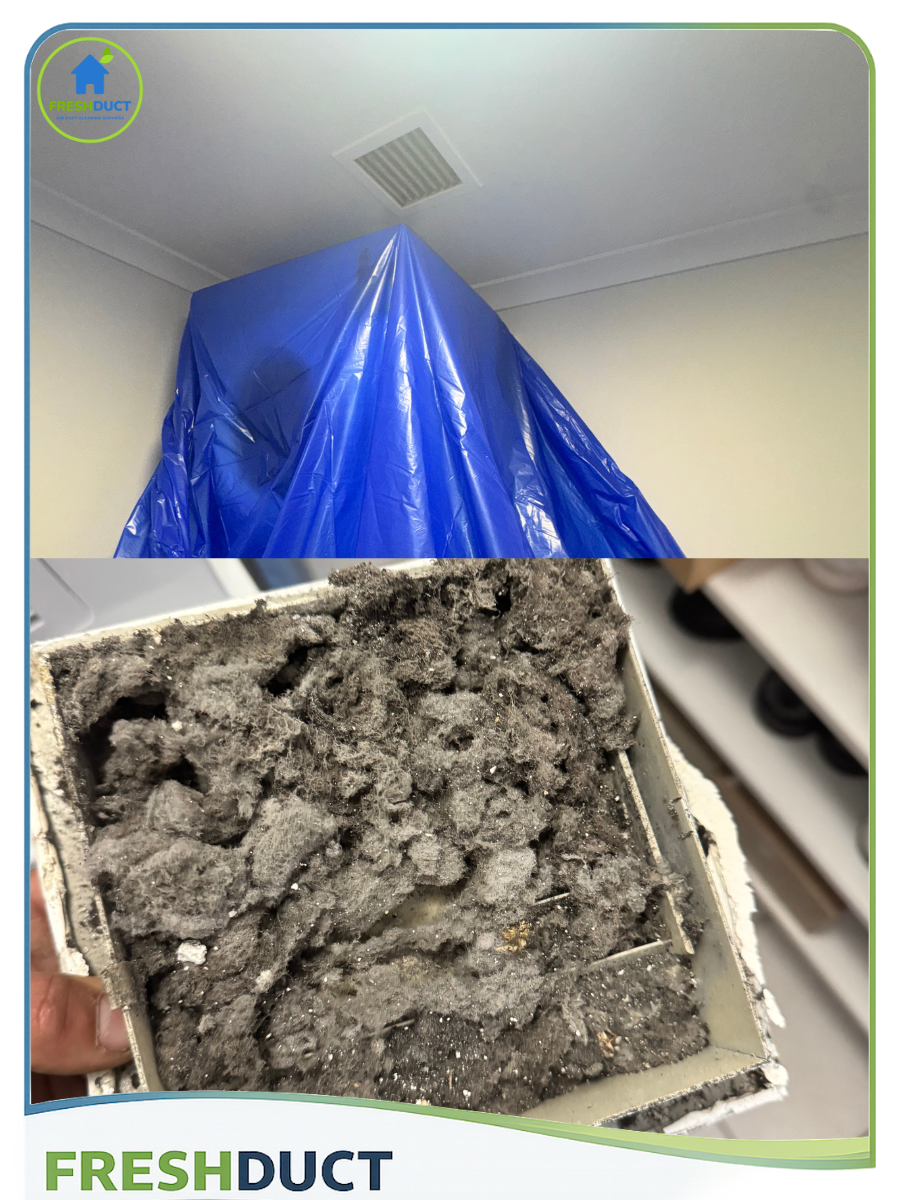

Every remediation starts with finding where the water is coming from. We inspect the affected areas, check ventilation and extraction performance, look at the roof space and gutters where relevant, and distinguish condensation from rising damp from an active leak. Those three problems look similar on the wall and need completely different fixes.
Treatment then addresses the material properly rather than cosmetically — affected surfaces cleaned and treated, contaminated porous material removed where it cannot be salvaged, and the area dried. You get a written summary of the cause and what needs to change, which is the part that actually stops it recurring next winter.
Book an Adelaide Mould AssessmentWe assess and treat mould across metropolitan Adelaide and the Hills. The pattern varies by housing type: condensation-driven mould dominates in apartments and well-sealed modern homes, while rising damp is concentrated in the older stone and masonry stock through the inner suburbs — Norwood, Unley, Goodwood, Prospect, Thebarton, Semaphore and Port Adelaide among them.
The Adelaide Hills is its own case. Genuinely cold winters, higher rainfall than the plains, heavy tree cover and shaded aspects at Stirling, Aldgate and Bridgewater mean surfaces stay cold and damp for longer, and south-facing rooms in particular are prone. We service the Hills as part of our regular runs.
Diagnose the moisture, treat the material, document the cause.
We identify the moisture mechanism before proposing treatment.
Extraction performance measured, discharge paths traced.
Affected areas isolated so spores are not spread through the home.
Surfaces treated; unsalvageable porous material removed.
The area dried properly rather than sealed over damp.
What caused it, what we did, and what must change.
Verified 5-star reviews from across FreshDuct’s duct, heating, cooling, chimney and insulation services. These are company-wide reviews from our established customer base — the same technicians and standards we bring to Adelaide.
“Allen provided exceptional service — friendly, professional and went above and beyond.”
“Highly impressed with the professionalism and efficiency. On time, and no mess left behind.”
“Exceeded my expectations. Knowledgeable, meticulous and respectful of our home.”
“So glad I chose FreshDuct. Knowledgeable team and the whole process was smooth from start to finish.”
“Quick, efficient and professional — we could immediately feel the difference.”
“The technician arrived on time and was incredibly thorough — the difference at home is obvious.”
Mould is usually a ventilation or moisture problem — these are the fixes.
Because Adelaide’s rainfall is winter-dominant and houses are closed up during exactly those months. Warm, moist indoor air from showers, cooking and drying laundry meets cold external surfaces and condenses there. It recurs in the same spots each year because the cold surfaces — external walls, window reveals, south-facing rooms — do not move.
They look similar on the wall but behave differently. Condensation appears on cold surfaces, typically higher up, around windows or behind furniture, and worsens in winter. Rising damp appears in the lower part of a wall, often with salt efflorescence, and is common in Adelaide stone homes built without an effective damp-proof course. We identify which one you have before treating.
We can, but on its own that is a temporary result. Unless the moisture source is found and addressed the growth returns to the same place, usually within a season and usually deeper into the material. Our assessment identifies the source first, because that is what determines whether the treatment lasts.
Yes. Mould is a common dispute point between Adelaide tenants and landlords, and a documented assessment identifying the actual moisture source is far more useful to both parties than a cleaned surface. Our written report sets out the cause, what was treated and what repair or change is needed.
It can be, particularly for people with asthma, allergies or compromised immunity, which is why we contain the work area rather than disturbing growth freely. We are remediation specialists rather than medical practitioners — if anyone in the household has symptoms they associate with the mould, that is a conversation for your doctor.
We find the moisture source, treat the affected material and document the cause — so it does not come back next winter.
Tell us where the mould is and how long it has been there.