★★★★★
“Allen provided exceptional service — friendly, professional and went above and beyond.”
JVerified
Jane
Wantirna South, VIC

FreshDuct cleans and inspects complete wood heater flue systems across Melbourne — every section from the appliance spigot to the cowl, including the parts inside your ceiling and roof space.
Flue systems are assemblies, not pipes. Every joint, guard and flashing is a component that can fail.
People tend to think of a wood heater flue as a single pipe going up. It is not. A modern flue system is an assembly of engineered components: the appliance connector, sections of twin-skin or triple-skin flue, a ceiling penetration guard, a roof flashing, a storm collar, and a cowl or terminal at the top. Each is a component with a function, and each can fail.
The multi-skin construction is worth understanding because it explains a lot. An inner flue carries the hot combustion gases while an outer casing, separated by an air gap or insulation, keeps the external surface temperature down. That is what allows a flue to pass safely through a timber-framed ceiling and roof at the clearances the system is designed for. If the inner and outer are compromised or incorrectly assembled, that protection is not doing what it should.
The hidden sections are where the risk concentrates. Inside a ceiling cavity and roof space, a flue joint that has worked loose over years of thermal cycling leaks combustion gas into an enclosed space full of timber and insulation. There is no smoke in the room to tell you. The ceiling guard may have been omitted, or insulation may have been packed up against the flue by a well-meaning installer years later. None of it is visible from the living room.
At the top, the flashing and storm collar keep water out of the roof, and the cowl keeps rain, birds and downdraught out of the flue. Flashings perish, storm collars work loose, and cowls corrode, fill with debris or blow off entirely. This is why we go on the roof where access is safe rather than sweeping from the room and calling the system inspected.
Each is a part with a function, and each fails in its own way.
Section by section, including the parts nobody sees.
Sectional flues rely on every joint being fully engaged and secured. Thermal cycling can work one loose over years, and in a ceiling or roof space that means combustion gas leaking into an enclosed cavity with no warning in the room. We check the joints along the whole run rather than only where we can reach from the floor.
The ceiling guard maintains the air gap that keeps the flue safe where it passes through a timber-framed ceiling. We check it is present and correct, and specifically for ceiling insulation that has been pushed or blown up against the flue during a later insulation job. That is a genuinely common and genuinely serious finding.
The flashing and storm collar are the only things keeping water out where the flue passes through the roof. Flashings perish and lift, and collars work loose. Water entering here runs down inside the roof space and the damage often shows up as a ceiling stain somewhere unrelated.
Cowls corrode, fill with debris, get damaged by falling branches and occasionally blow off entirely. A blocked or missing cowl affects draught immediately and lets rain into the flue, which accelerates corrosion from the inside. We inspect it from the roof where access is safe and photograph the condition.
Flue components corrode over decades, most severely where the flue runs cool and where condensate collects. We look for perforation, staining and deterioration along the run, because a flue with a hole in it inside a roof space is discharging into the building rather than above it.
FreshDuct recommends the full flue system be swept and inspected annually before the season. The appliance may be perfectly serviceable while the flue system has a loose joint, insulation contact or a failed flashing, and those are the faults that give you no warning at all.
Real FreshDuct flue, roof and termination photography from Melbourne jobs.


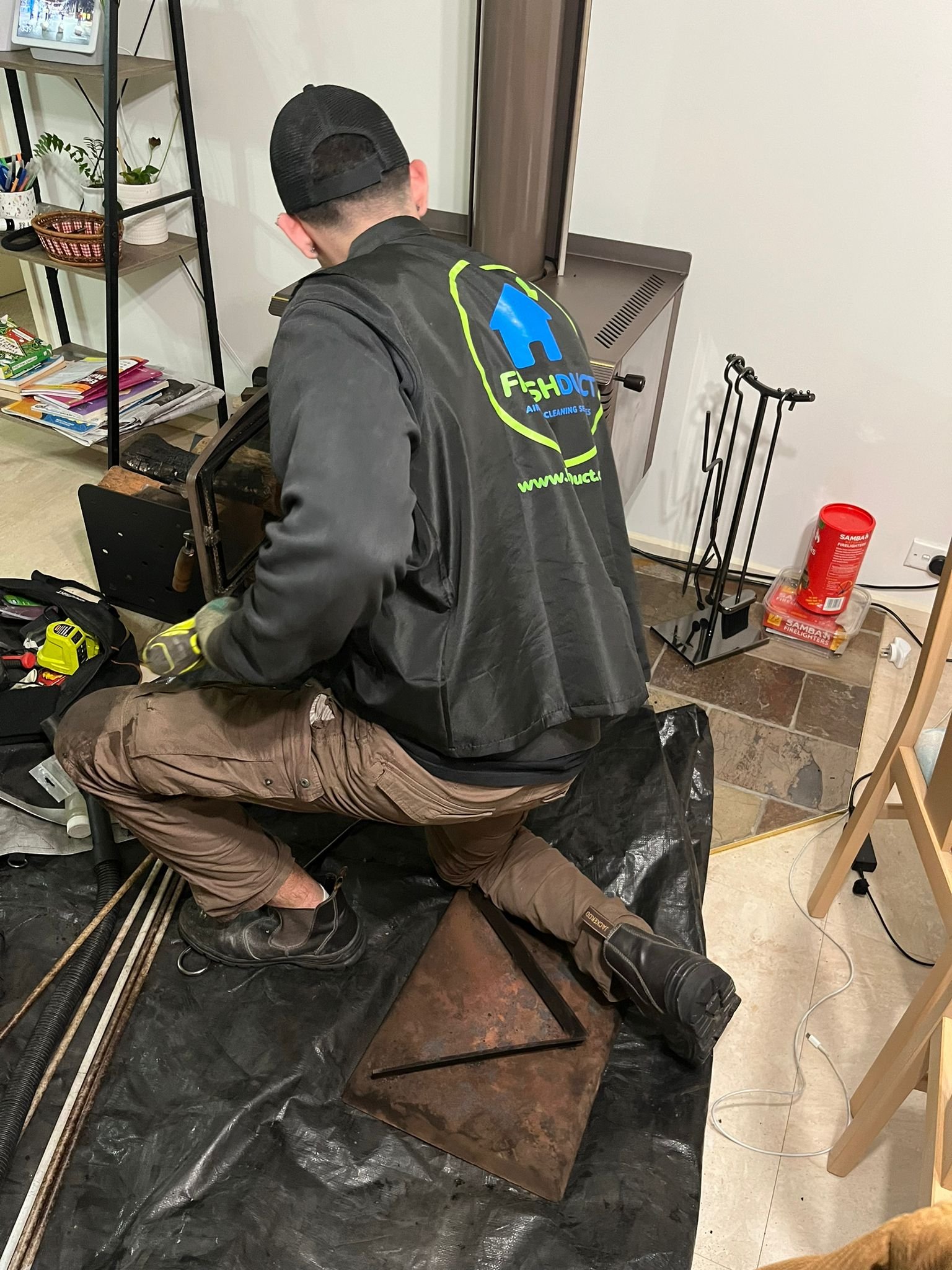
We sweep the flue from the appliance spigot to the terminal, check joint engagement along the run, inspect the ceiling penetration and its guard, look specifically for insulation pushed against the flue, and inspect the flashing, storm collar and cowl from the roof where access is safe. Corrosion and perforation are checked along the whole system.
You get photographs of the flue interior and the roof termination — the two parts of your system you have never seen — along with a written condition note. Where flue components need replacing or an installation issue needs rectifying, we quote the flue work we can do and refer installation compliance work to a suitably qualified installer.
Book a Flue System InspectionWe inspect and clean wood heater flue systems throughout Melbourne. Complete sectional flue systems dominate the outer suburbs and growth corridors — Craigieburn, Melton, Pakenham, Berwick, Cranbourne, Ringwood and Croydon — where heaters were installed into homes built without chimneys.
They are equally common through Eltham, Warrandyte, Greensborough, the Dandenong Ranges, the Yarra Valley and the Macedon Ranges, where heaters run long hard seasons and flue systems earn their inspection. Older installations out there frequently have flue systems of the same vintage as the appliance, which is precisely when corrosion and loose joints start appearing.
Component by component, from the spigot to the cowl.
Flue type, diameter and how the run is configured.
Floor and hearth covered, extraction running before we open up.
Spigot to terminal, with debris captured at the appliance.
Ceiling guard, insulation contact and joints in the cavity.
Flashing, storm collar and cowl checked where access is safe.
Images of the flue interior and roof termination, plus a written note.
Verified 5-star reviews from across FreshDuct’s chimney, fireplace, duct, heating and insulation services. These are company-wide reviews from our Melbourne customer base — not reviews of any particular appliance brand.
“Allen provided exceptional service — friendly, professional and went above and beyond.”
“Highly impressed with the professionalism and efficiency. On time, and no mess left behind.”
“Exceeded my expectations. Knowledgeable, meticulous and respectful of our home.”
“So glad I chose FreshDuct. Knowledgeable team and the whole process was smooth from start to finish.”
“Quick, efficient and professional — we could immediately feel the difference.”
“The technician arrived on time and was incredibly thorough — the difference at home is obvious.”
What flue system inspections most often lead to.
It is a flue built with an inner pipe carrying the hot gases and one or more outer casings separated by an air gap or insulation. The construction keeps the external surface temperature down, which is what allows the flue to pass safely through a timber-framed ceiling and roof at the clearances the system is designed for.
It should not, and it is one of the more serious things we find. Insulation packed or blown up against a flue during a later insulation job defeats the air gap the system depends on. It is common, it is invisible from the room, and we check for it specifically on every flue system inspection.
Because the flashing and storm collar are the only things keeping water out of the roof at the penetration, and the cowl is what keeps rain, birds and downdraught out of the flue. All three fail over time, none can be assessed from inside, and water entering there often shows up as damage somewhere apparently unrelated.
It varies considerably with the quality of the system, how hard the heater is run and how much condensation the flue sees. What we can say is that corrosion concentrates where the flue runs cool and at the terminal, and that a flue of the same vintage as a twenty-year-old appliance deserves genuine inspection rather than assumption.
Yes, flue repair and component replacement is work we carry out. Where the issue is an installation compliance matter rather than a worn component, we refer that to a suitably qualified installer. We photograph everything and quote the honest remedy rather than the largest one.
The full system swept and inspected from spigot to cowl, including the ceiling cavity and the roof, with photographs of both.
Tell us the flue type and rough age if you know them.