 FreshDuct
It creeps up slowly. A load of towels that used to come out dry now needs another half hour, then a full second cycle. Through a wet Melbourne spring, when the clothesline is no help, that extra cycle every load adds up quickly, and many people assume the dryer is simply getting old.
Quick answer: If a vented dryer has started needing two cycles, check the airflow first: a full lint filter, a crushed or kinked duct, lint packed inside the duct or a stuck outlet flap all trap hot, damp air in the drum. If the vent is clear and air flows strongly outside, the cause is more likely the dryer itself, such as a coated moisture sensor or a heating fault.
Sometimes it is. But with a vented dryer, one of the most common reasons for slow drying has nothing to do with the dryer at all. It is the path the air takes out of the house. This post explains how a restricted vent slows drying, how to tell a vent problem from an appliance fault, and when to get the vent cleaned.
How a vented dryer actually dries clothes
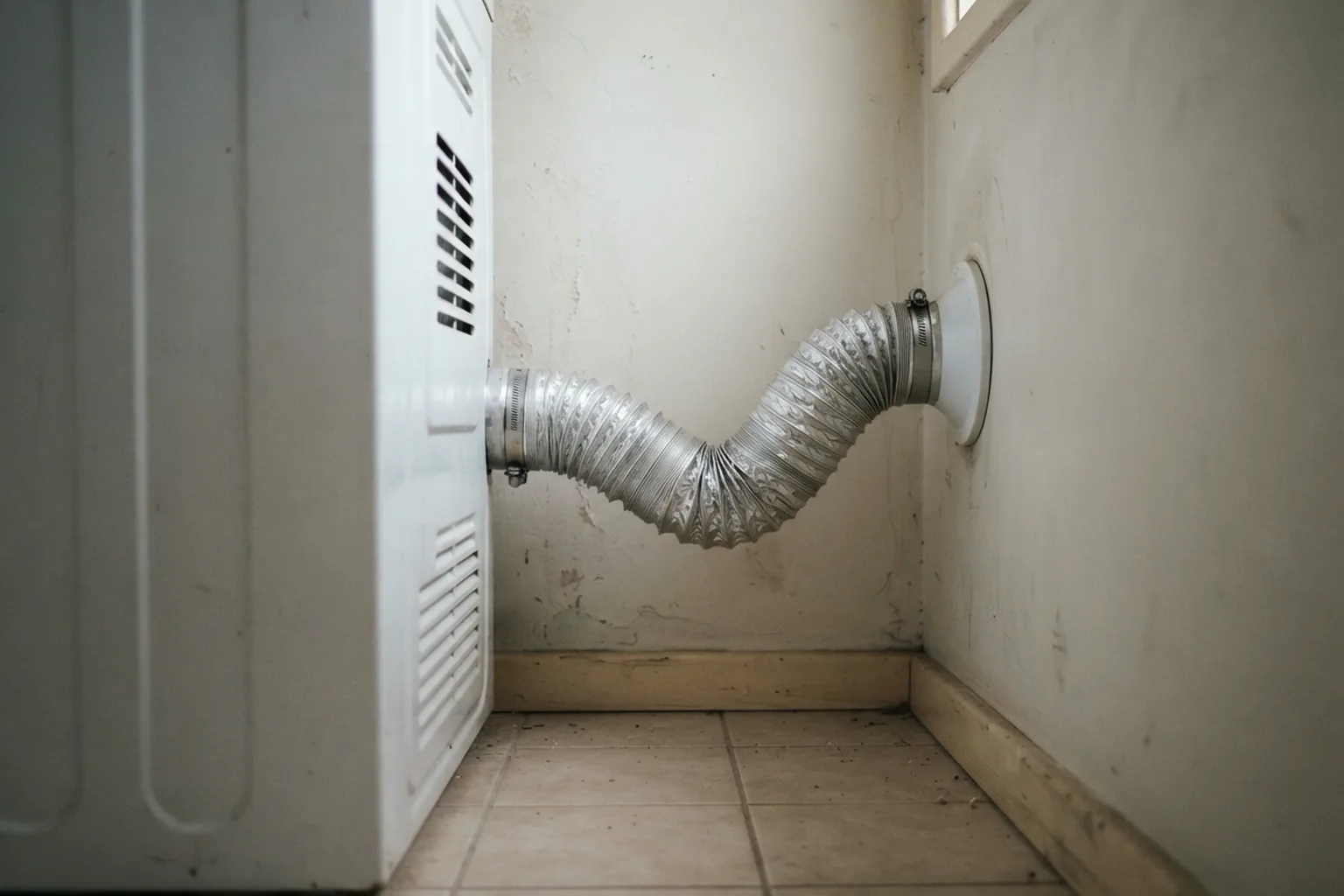
A vented dryer does three things at once. It heats air, tumbles the clothes through that warm air so the water evaporates, and pushes the now damp air out through a duct to the outside. The drying depends on that last step as much as the first two. If the damp air cannot leave quickly, the drum fills with warm humid air that can hold very little more moisture, and the clothes stop drying efficiently.
That is why airflow matters so much. A dryer with a perfectly good heater will still struggle if the air it is trying to push out has nowhere to go.
Where the airflow gets restricted
There are only a handful of places a vent can choke, and most of them can be found with a quick look.
- The lint filter. The simplest one. A filter that is not emptied every load, or one coated with a waxy film from fabric softener and dryer sheets, cuts airflow at the source.
- The duct behind the dryer. Flexible foil duct is easily crushed when the dryer is pushed back against the wall, kinked around a corner or left sagging in a loop where lint settles.
- Lint inside the duct. Lint that gets past the filter builds up along the inside of the run, especially at bends and low points.
- The outside outlet. The flap can stick shut, get clogged with lint, or be blocked by a bird nest, a garden bed or something stored against the wall.
- A run that is too long or has too many bends. Every bend adds resistance, and some laundries were set up with a run the dryer was never going to push air through well.
In many Melbourne homes the laundry sits in the middle of the house, or in a townhouse or apartment where the duct has to travel through a wall, up into a ceiling and out through a side or roof outlet. Those longer, hidden runs are the ones most likely to collect lint where nobody can see it. The section behind the dryer is easy to check yourself: pull the machine out carefully, look for crushing or sagging, and make sure both ends are still connected. Anything beyond that, inside the wall or ceiling, is out of sight and needs proper equipment to clear.
Checks that point to the vent or the dryer
A few quick checks usually tell you which way to look. Clean the lint filter first, then run the dryer on a heat setting and go outside to the vent.
- Strong, warm airflow at the outlet and a flap that opens fully suggest the vent is doing its job.
- Weak or no airflow, a flap that barely moves or lint gathered around the outlet point to a restriction somewhere in the run.
- A hot, humid laundry or condensation on the walls while the dryer runs suggests damp air is not leaving the house properly.
- The top and sides of the dryer feeling very hot to the touch is another sign the hot air is trapped.
- The drum not warming up at all points to the dryer rather than the vent.
When it is the dryer, not the vent
If the vent is clear and the air flows strongly outside, the slow drying is more likely to be the appliance or the way it is being used. Common causes include overloading the drum so air cannot move through the clothes, washing on a low spin speed so clothes go into the dryer wetter, a moisture sensor coated with fabric softener residue that ends the cycle too early, and faults with the heating element or thermostat. Sensor bars can often be wiped clean following the owner manual. Electrical faults are a job for an appliance technician.
Condenser and heat pump dryers are a separate case. They do not vent outside, so when they slow down, check the lint filters and the condenser or heat exchanger as the manual describes.
Why a slow dryer is worth acting on
An extra cycle costs electricity and time, but the bigger reason to act is safety. Lint is extremely flammable. A restricted vent means the dryer runs hotter and for longer, with lint collecting along a duct that is often hidden behind the machine or inside a wall. Slow drying is one of the earliest signs that this is happening.
It is also worth knowing where your dryer actually vents. If the duct ends in the roof space or a wall cavity rather than outside, the lint and moisture are collecting inside the house, and that needs fixing regardless of how well the dryer is drying.
Getting the vent cleaned
A professional dryer vent clean clears the whole run, from the back of the dryer to the outside outlet, not just the first section you can reach. The duct is checked for crushing, kinks and sags along the way, and the outlet flap is cleared so it opens freely. Every job comes with before and after photos, so you can see what came out of the duct.
There is no call-out fee and you pay after the job is done. If your dryer has slowed down this spring, clean the lint filter, try the airflow check above, and if the air outside is weak, book a vent clean before you start shopping for a new dryer.
Helpful FreshDuct services & guides
Frequently asked questions
Why does my dryer take so long to dry clothes?
A vented dryer works by heating air, passing it through the clothes and pushing the damp air out through the vent. If the vent is restricted, the damp air cannot leave, so the clothes sit in warm humid air and dry slowly. Overloading, a full lint filter, clothes that were not spun well in the washer and faults in the dryer itself can all cause the same symptom.
How can I tell if my dryer vent is blocked?
Run the dryer on a heat setting and go to the outside vent. You should feel a strong, warm flow of air and see the flap open. Weak or no airflow, a flap that stays shut, lint around the outlet, a laundry that feels hot and humid, or the top of the dryer getting very hot are all signs the vent is restricted.
Does this apply to condenser and heat pump dryers?
Not in the same way. Condenser and heat pump dryers do not vent outside, so there is no external duct to block. When they slow down, the usual suspects are the lint filters, the condenser unit or heat exchanger that needs cleaning, and the water container or drain. The owner manual explains how to clean those parts on your model.
Can a blocked dryer vent be dangerous?
Yes. Lint is highly flammable, and a restricted vent makes the dryer run hotter and longer. That combination is why a dryer that has slowed down is worth checking promptly rather than living with an extra cycle. Never vent a dryer into a roof space or wall cavity, as the lint and moisture build up there out of sight.
Get a fast, free quote
Talk to FreshDuct about dryer vent across Melbourne — 7 days a week, clear upfront pricing, 600+ 5-star reviews.