 FreshDuct
★★★★★
“Allen provided exceptional service — friendly, professional and went above and beyond.”
JVerified
Jane
Wantirna South, VIC
Some people are using the FreshDuct name and pretending to be us to scam customers. Please don't fall for it. We are the only genuine FreshDuct, operating in Melbourne, Sydney, Adelaide and Perth. Only deal with us through freshduct.com.au, or call us directly on 04 3191 8137 or 0480 004 051. We are taking legal action against these impostors. Thank you.
No Australian capital asks more of a ducted heater than Canberra does. FreshDuct cleans and services the whole system — unit, heat exchanger surrounds, returns, floor ducts and grilles — so it is ready before the first hard frost, not during it.
Heating jobs fill from March. Book while the weather still lets you go without it.
Canberra is the capital where heating genuinely matters. The Bureau of Meteorology long record for Canberra Airport puts the July mean minimum at -0.1°C and the July mean maximum at 11.4°C, with 92 days a year at or below 2°C and a lowest recorded temperature of -10.0°C. The mean daily ground minimum in July is around -2.8°C. A ducted heater here runs long hours, most days, for the better part of half the year.
Run hours are what age a heating system. Burners and heat exchangers cycle, fans run, filters load, and the duct network downstream carries whatever the unit puts into it. A system that would comfortably go three years between services in Brisbane is doing several times the work in Ainslie or Kambah, and it shows up as reduced airflow, uneven room temperatures, longer run times to reach setpoint, and a burning-dust smell that never quite goes away.
There is also a safety dimension that a mild climate lets people ignore. A combustion heater that runs a few weeks a year is forgiving. One that runs from April to October is not. Blocked returns, restricted airflow and a fouled combustion chamber are exactly the conditions that stress a heat exchanger, and a compromised heat exchanger on a gas ducted system is the one fault you genuinely do not want to discover in July.
What a Canberra winter actually asks of a ducted heating system, in Bureau of Meteorology numbers.
The faults a long, hard heating season produces — and the ones worth finding before winter rather than during it.
Almost every “the heating is not working properly” call in Canberra turns out to be airflow. A loaded filter, a partially blocked return, a duct that has come off its collar in the roof space, or floor registers buried under furniture and rugs. Restricted airflow makes the unit run longer and hotter to reach setpoint, which costs you money and shortens the life of the most expensive component in the box.
On gas ducted heating we check the combustion chamber and heat exchanger surrounds, the flue and its terminal, and the return-air sealing — because a return drawing from the same space as the appliance is a genuine risk, not a technicality. With Canberra systems running most days from April to October, small combustion faults get a lot of hours to become large ones.
The ACT Government has committed to phasing out fossil fuel gas by 2045 at the latest, fossil fuel gas accounts for more than 20 per cent of the Territory’s emissions, and since 8 December 2023 new gas network connections have been prevented. That does not mean your gas ducted heater stops working tomorrow. It does mean a clear-eyed view of what to spend: service and clean a sound unit, think hard before a major repair on an old one, and plan the replacement on your timeline rather than on a July breakdown.
A great deal of Canberra housing around the Woden and Belconnen town centres, which opened in 1971 and 1977, uses underfloor or in-slab heating ducts rather than ceiling runs. Those systems collect everything that falls through a floor register and they are frequently never cleaned because the grille looks fine. Lifting the registers is often the most revealing five minutes of the visit.
Braddon’s first stage dates from 1921-22 and Reid from 1926-27, and heating in that stock is always a retrofit. Runs threaded through a shallow roof space, sometimes above thin or degraded insulation, with joints that have had decades to work loose. We check the roof-space portion of the system as carefully as the unit, because that is where the losses usually are.
A ducted heater does not just make heat, it moves the entire air volume of your house through a network you never see. If that network is carrying accumulated dust, degraded insulation fibre or condensation residue, a Canberra winter means breathing it for six months with the windows shut. Cleaning the ducts and returns is as much of the service as tuning the unit.
Real FreshDuct heating and duct work, photographed before and after on every job.
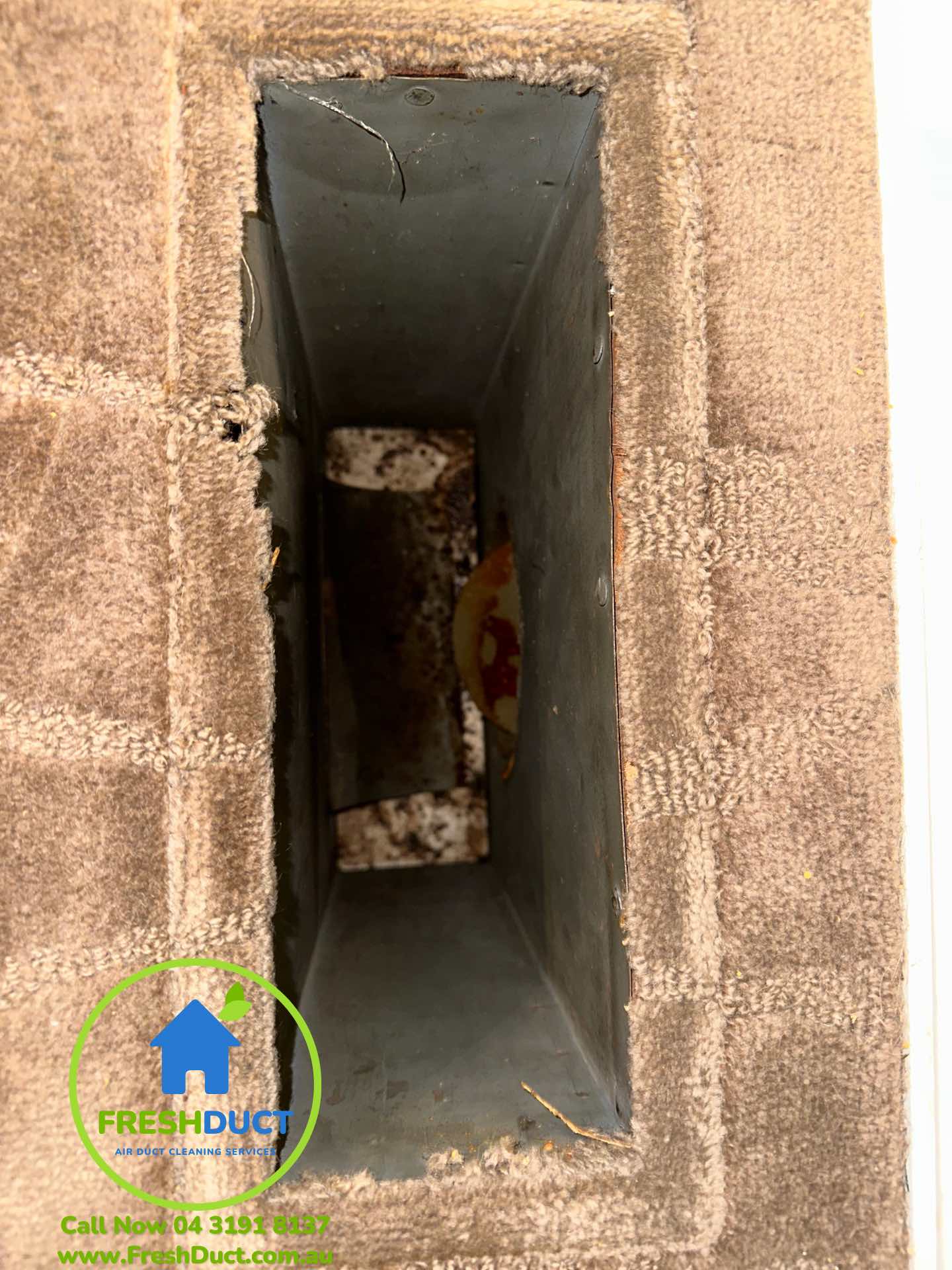
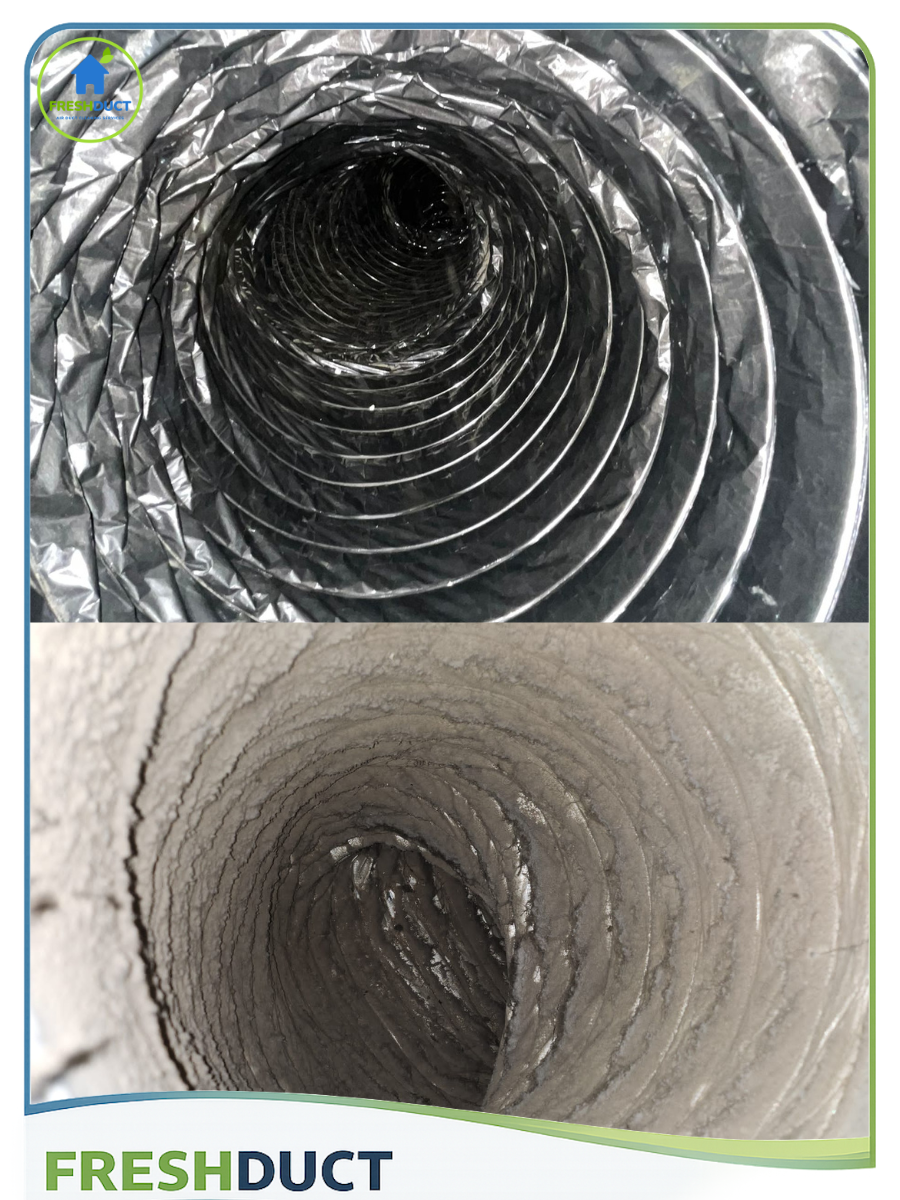
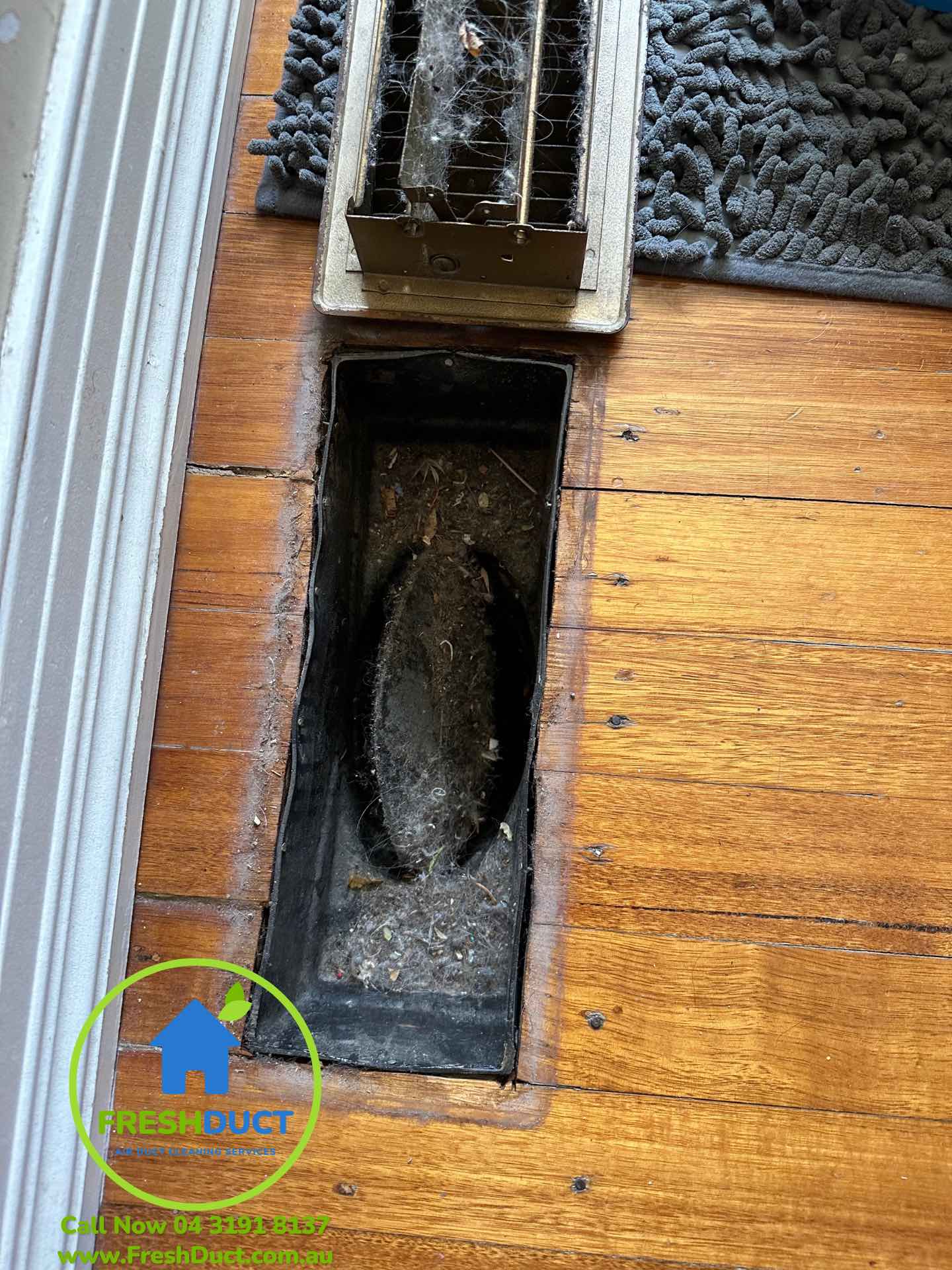
Servicing the box and ignoring the ducting is the most common half-job in this trade. We do both: filters, fan and blower assembly, burner and combustion chamber surrounds, flue and terminal, thermostat operation and safety checks on the unit; then the returns, the plenum, every supply run and every register on the network it feeds. On the underfloor systems that are so common through Woden, Weston Creek and Belconnen, the registers come up and the runs get cleaned properly.
You get before and after photos of the actual system, a clear statement of anything that needs attention, and an honest read on where the unit is in its life. If it is sound, we say so and you get a clean system for a small spend. If it is not, we say that too — with the ACT gas phase-out running to 2045, knowing whether you are two years or ten years from a replacement is worth having well before a July breakdown makes the decision for you.
Book a Heating ServiceWe service and clean ducted heating across every Canberra district — the Inner North through Braddon, Turner, Dickson, Ainslie and O’Connor; the Inner South through Kingston, Griffith, Narrabundah, Yarralumla and Deakin; Woden and Weston Creek including Curtin, Phillip, Weston and Holder; Belconnen including Bruce and Kaleen; Gungahlin through Ngunnawal and Amaroo; and Tuggeranong including Kambah. Queanbeyan is covered as well.
Timing matters more for heating than for any other service we offer. Demand climbs sharply from March, and by the time the first hard frost arrives the whole trade is booked. Late summer and early autumn is when you get your pick of appointment times, and when a fault we find can be fixed without you living through it.
Unit, returns and full duct network — assessed, cleaned and documented.
We run the system and measure how it actually performs before touching it.
Unit internals, combustion surrounds, flue, returns and the duct network.
A firm price on what the system needs, before work starts.
Filters, fan, burner surrounds and safety checks done properly.
Returns, plenum, supply runs and registers, lifted and cleared.
Before and after images and an honest read on the system’s remaining life.
Verified 5-star reviews from across FreshDuct’s duct, heating, cooling, chimney and insulation services. These are company-wide reviews from our established customer base — the same technicians and standards we bring to Canberra.
“Allen provided exceptional service — friendly, professional and went above and beyond.”
“Highly impressed with the professionalism and efficiency. On time, and no mess left behind.”
“Exceeded my expectations. Knowledgeable, meticulous and respectful of our home.”
“So glad I chose FreshDuct. Knowledgeable team and the whole process was smooth from start to finish.”
“Quick, efficient and professional — we could immediately feel the difference.”
“The technician arrived on time and was incredibly thorough — the difference at home is obvious.”
Heating work pairs naturally with these Canberra services.
Late summer or early autumn. Canberra Airport averages 59 nights a year at or below 0°C and 92 days at or below 2°C, so the heating season effectively runs April to October and demand across the trade climbs sharply from March. Servicing in February or March means any fault we find gets fixed while you can still live without heat.
Usually yes, and here is the honest framing. The ACT has committed to phasing out fossil fuel gas by 2045 at the latest and has prevented new gas network connections since 8 December 2023, but that is a long runway. A service and clean is a small spend that keeps a sound unit safe and efficient. What changes is the threshold for a major repair — on an old unit, that money is often better put toward a planned replacement. We will give you a straight read either way.
Yes, and we think servicing one without the other is half a job. The unit makes the heat but the duct network delivers it, and in Canberra that network runs almost year-round between heating and cooling. We do filters, fan, burner surrounds, flue and safety checks on the unit, then returns, plenum, every supply run and every register — including lifting floor registers on underfloor systems.
In Canberra it is usually one of three things: a duct that has come off its collar or partially collapsed in the roof space, a run that is simply too long or too restricted for the branch, or a register that has been closed or covered. All three are findable with a camera and most are fixable on the day. It is one of the most common calls we get and one of the most satisfying to solve.
Every ACT district — Inner North, Inner South, Woden, Weston Creek, Belconnen, Gungahlin and Tuggeranong — plus Queanbeyan. Because Canberra is compact we can usually offer a firm appointment time rather than a half-day window.
Unit serviced, full duct network cleaned, photo proof and an honest read on what your system has left. Available 7 days.
Tell us the system type and suburb and we will come back fast.