 FreshDuct
★★★★★
“Allen provided exceptional service — friendly, professional and went above and beyond.”
JVerified
Jane
Wantirna South, VIC
Some people are using the FreshDuct name and pretending to be us to scam customers. Please don't fall for it. We are the only genuine FreshDuct, operating in Melbourne, Sydney, Adelaide and Perth. Only deal with us through freshduct.com.au, or call us directly on 04 3191 8137 or 0480 004 051. We are taking legal action against these impostors. Thank you.
Mould is a moisture problem wearing a stain. FreshDuct finds where the water is coming from, fixes the ventilation failure behind it, then treats the growth — in that order.
Wiping it off and repainting is why it came back. The moisture source is still there.
People are often surprised that mould is a problem in a city known for dry heat. The explanation is in the rainfall pattern: 77.7 per cent of Perth’s 723.9 mm annual rainfall falls between May and September. For those months the city is genuinely wet, houses are closed up against the weather, heating is running and internal moisture has nowhere to go.
That is the combination mould needs. Warm moist air from showers, cooking and drying clothes indoors condenses on the coldest surfaces in the house — window reveals, external wall corners, behind wardrobes on south-facing walls, and ceilings above bathrooms. Where extraction has failed, which is extremely common, that moisture simply accumulates week after week until growth establishes.
Perth’s building stock adds its own factors. Solid masonry and limestone walls in older character homes have no cavity and can transfer moisture directly, and many of those houses predate any effective damp course. Meanwhile modern apartments are sealed far more tightly than older housing, so a single failed bathroom fan has a much larger effect. Either way, the growth is the symptom and the moisture path is the actual job.
Why Perth mould appears in the cooler months.
The moisture sources behind the growth, which is what actually has to be fixed.
The single most common cause we find. A bathroom fan that spins without extracting, or a laundry with no mechanical ventilation, leaves every shower’s worth of moisture in the building. Treating the ceiling without restoring extraction guarantees the growth returns the following winter.
Through the wet months, warm moist internal air condenses wherever a surface is cold enough — window reveals, uninsulated external wall corners, and behind furniture pushed against south-facing walls. The pattern of growth usually tells us exactly which surfaces are the problem before we take a single reading.
Character housing in Subiaco, Fremantle, Guildford and Bassendean often has solid masonry or limestone walls with no cavity and no effective damp course. Ground moisture and driven rain move directly through the wall. That needs identifying properly, because it is a different problem from condensation and responds to different work.
Wet-season roof leaks, and exhaust fans or dryers discharging into the roof cavity, both saturate insulation and ceiling material from above. Ceiling mould with no obvious room-level cause is very often coming from the cavity, so we get up there and look.
Suspended timber floors in older Perth homes need ventilated subfloors. Blocked or built-over vents through renovations and landscaping trap moisture underneath the house, and it comes up through the floor. It is a common finding and a frequently missed one.
Surface treatment is the cheap part and the part that fails. We will not quote a clean-and-seal on a wall that is wet for a structural reason, because it will not hold and you will have paid for nothing. Diagnosis first, then the appropriate work.
Real FreshDuct mould treatment and related ventilation work.

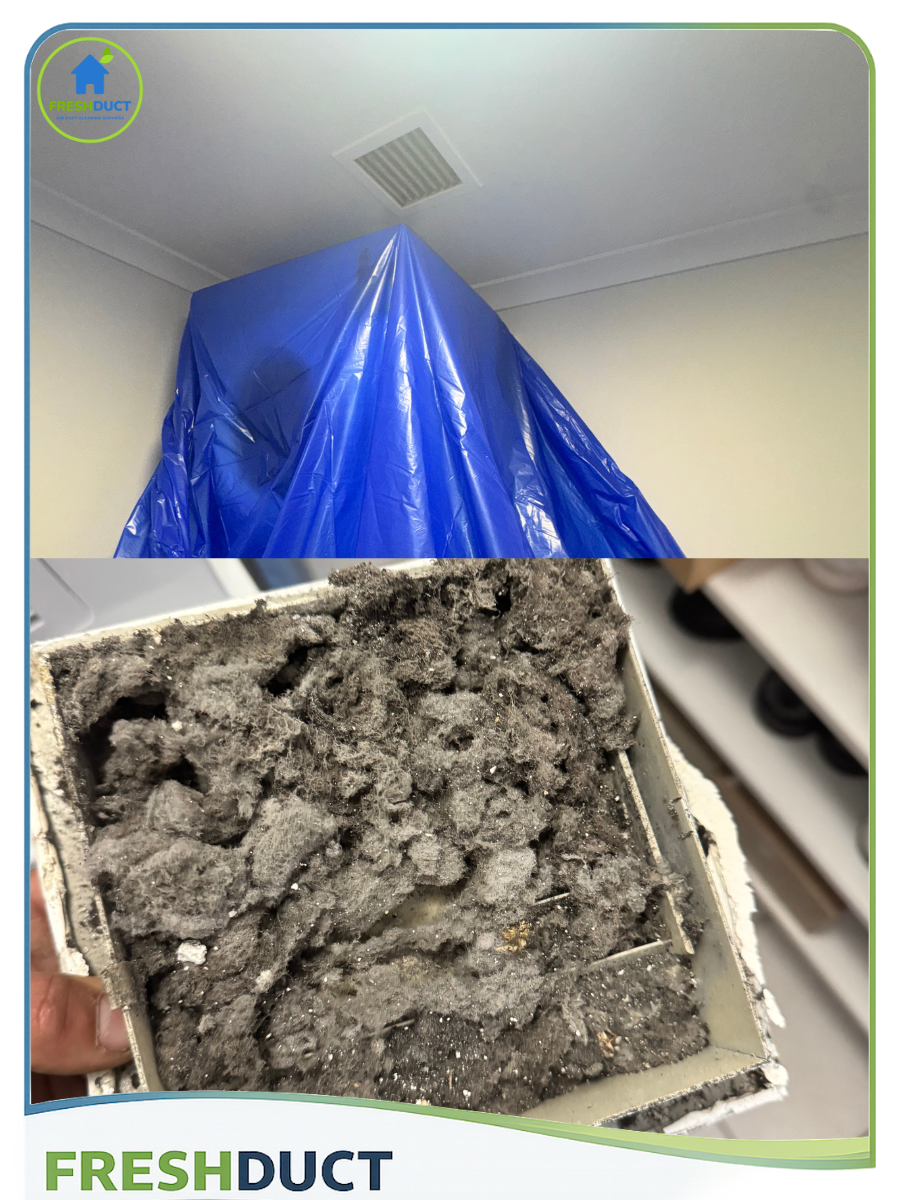

We start with diagnosis: where the moisture is coming from, whether extraction is actually working, whether the roof space or subfloor is contributing, and whether the pattern points to condensation, a leak or rising damp. That assessment determines the whole job, and we photograph what we find so the reasoning is visible to you.
Then we treat the affected areas properly with appropriate containment, and fix or quote the moisture path — restoring extraction, correcting a duct that discharges into the roof cavity, clearing subfloor vents. If the underlying cause is a building defect outside our scope, we will tell you that plainly rather than selling a treatment that cannot last.
Book a Perth Mould AssessmentWe treat mould across metropolitan Perth in houses, apartments and rental properties. The character suburbs — Subiaco, Fremantle, Guildford, Bassendean — bring solid-wall and rising damp cases, where identifying the mechanism correctly matters more than the treatment itself.
Apartments through the Perth CBD, South Perth, Victoria Park and Applecross bring the opposite problem: tightly sealed buildings where a single failed bathroom fan produces significant growth in one winter. In both cases we work to the same order — diagnose the moisture, fix the path, then treat the growth.
Diagnosis first. Treatment second. That order is the whole point.
We identify the actual water source before quoting any treatment.
Extraction tested, duct runs traced, roof space and subfloor inspected.
Affected zone contained so treatment does not spread spores through the home.
Appropriate treatment for the surface and the extent of the growth.
Extraction restored, ducts corrected, vents cleared — or quoted separately.
Before and after images plus a plain-English explanation of the cause.
Verified 5-star reviews from across FreshDuct’s duct, heating, cooling, chimney and insulation services. These are company-wide reviews from our established customer base — the same technicians and standards we bring to Perth.
“Allen provided exceptional service — friendly, professional and went above and beyond.”
“Highly impressed with the professionalism and efficiency. On time, and no mess left behind.”
“Exceeded my expectations. Knowledgeable, meticulous and respectful of our home.”
“So glad I chose FreshDuct. Knowledgeable team and the whole process was smooth from start to finish.”
“Quick, efficient and professional — we could immediately feel the difference.”
“The technician arrived on time and was incredibly thorough — the difference at home is obvious.”
Mould work pairs naturally with these Perth services.
Because that is when the moisture is. Of Perth’s 723.9 mm average annual rainfall, 77.7 per cent falls between May and September. Through those months houses are shut against the weather, heating is running, and internal moisture from showers, cooking and indoor drying has no easy way out. It condenses on cold surfaces and growth follows.
Only temporarily, unless the moisture source is dealt with. Mould cannot grow without water, so if the underlying cause is a failed exhaust fan, a roof leak, a blocked subfloor vent or rising damp, surface treatment simply resets the clock until the next wet season. We diagnose first for exactly that reason.
Usually failed bathroom extraction in a tightly sealed building. Modern apartments are far less leaky than older housing, so mechanical ventilation is doing nearly all the work. Internal bathrooms with no window are the most exposed — when that fan stops extracting properly, a single winter is enough to produce significant growth.
Yes. Character housing in Subiaco, Fremantle, Guildford and Bassendean often has solid masonry or limestone walls with no cavity and no effective damp course, so ground moisture and driven rain can move directly through the wall. That is rising or penetrating damp rather than condensation, and it responds to different work — so identifying which one you have matters.
Yes, and it is a common job. Roof-space mould usually comes from a wet-season leak or from an exhaust fan or dryer discharging into the cavity instead of outside. We inspect the space, treat the affected material, and correct or quote the discharge problem — because treating the cavity while the fan keeps venting into it achieves nothing.
Moisture diagnosis, proper containment and treatment, and the ventilation fix behind it. Available 7 days.
Tell us where the growth is and how long it has been there.