 FreshDuct
★★★★★
“Allen provided exceptional service — friendly, professional and went above and beyond.”
JVerified
Jane
Wantirna South, VIC
Some people are using the FreshDuct name and pretending to be us to scam customers. Please don't fall for it. We are the only genuine FreshDuct, operating in Melbourne, Sydney, Adelaide and Perth. Only deal with us through freshduct.com.au, or call us directly on 04 3191 8137 or 0480 004 051. We are taking legal action against these impostors. Thank you.
Canberra ductwork runs harder than almost anywhere in Australia — heating from April through October, then cooling through a run of 30°C and 40°C days. FreshDuct cleans the full system, supply runs, returns and grilles, and photographs every metre of it.
Dusty smell on the first cold-morning start-up? That is the duct, not the unit.
Duct cleaning intervals published for coastal capitals do not translate to the ACT, because those cities give a ducted system months off. Canberra does not. Bureau of Meteorology figures for Canberra Airport show 59 nights a year at or below 0°C and 92 days at or below 2°C, which puts the heating season somewhere around April to October. Then the same ducts turn around and handle 43 days a year at or above 30°C and ten at or above 35°C.
That near-continuous duty cycle is the whole story. Every hour the fan runs, the return-air grille pulls household air and everything suspended in it back through the system — skin cells, carpet fibre, pet dander, cooking residue, and whatever the roof space has been shedding. Two heavy seasons a year with only a short shoulder between them means Canberra ducts accumulate roughly double what a mild-climate system does over the same calendar period.
Cold makes it worse in a way people rarely connect. When outside air is near freezing and the ductwork runs through an unheated roof space, the temperature differential across the duct wall is severe. Any leak, any poorly sealed joint, any gap where a flexible duct has pulled off a collar becomes a condensation point — and dust that has been sitting dry for years turns into something that sticks, mats and, given long enough, grows.
What actually drives duct contamination in the ACT, by mechanism rather than by marketing interval.
Canberra was built district by district, and the ductwork under each one is different. These are the patterns we plan around.
Braddon’s first stage went up in 1921-22 and Reid, the oldest continuously inhabited residential suburb in the city, was largely built in 1926-27. Nothing from that era was designed around ducted air. What is there now is retrofit — flexible duct threaded through a low, awkward roof space, often above minimal insulation, sometimes with runs that sag between joists and collect debris at the low point. Access is the job.
The Woden town centre opened in 1971 and Belconnen in 1977, and the housing around them shares a construction vocabulary: single-storey brick veneer, shallow roof pitch, tight ceiling space and, very often, in-slab or underfloor heating ducts rather than ceiling runs. Underfloor ducting collects differently — it catches what falls in through floor grilles, which in practice means dust, hair, coins, toys and a surprising amount of pet fur.
Tuggeranong opened in 1987 and Gungahlin in 1998, and the newer the estate the more likely the ducting is a modern ceiling-mounted layout in a taller roof space with better insulation. Those systems are easier to clean properly but they are not immune — construction dust from the build phase is the single most common thing we extract from a system under fifteen years old.
With a July mean minimum of -0.1°C and a mean daily ground minimum around -2.8°C, the unheated parts of a Canberra roof space get genuinely cold. Ducting running through that space while carrying warm air is a condensation risk wherever the insulation wrap has torn or a joint has opened. We look for the damp signature specifically, because it is the difference between a dusty duct and a contaminated one.
A duct system is only as clean as the space it lives in. Rodent activity, degraded old insulation, and debris that has worked in through eaves and tile laps all end up on top of ducting and, eventually, inside it. Where we find that, we say so and photograph it rather than cleaning the duct and leaving the source in place.
The ACT has legislated to phase out fossil fuel gas by 2045 at the latest, and new gas network connections have been prevented since 8 December 2023. If your ducted system is gas, that shapes how much you should sensibly spend on it. Cleaning and servicing an otherwise sound system is almost always the right call; major surgery on an old one is a conversation worth having first. We will tell you which you are looking at.
Real FreshDuct duct work. Every job is photographed before and after so you can see exactly what came out.
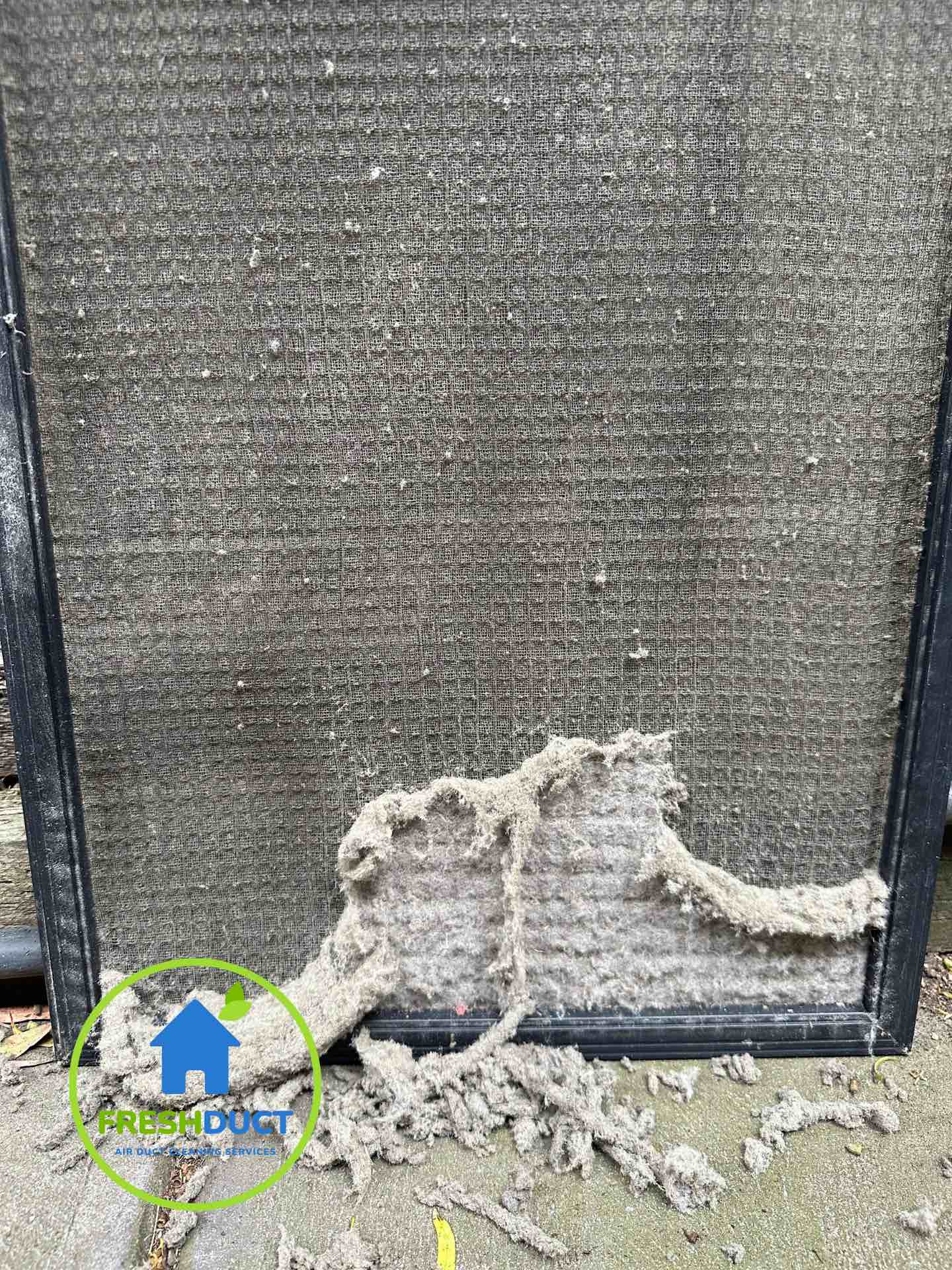
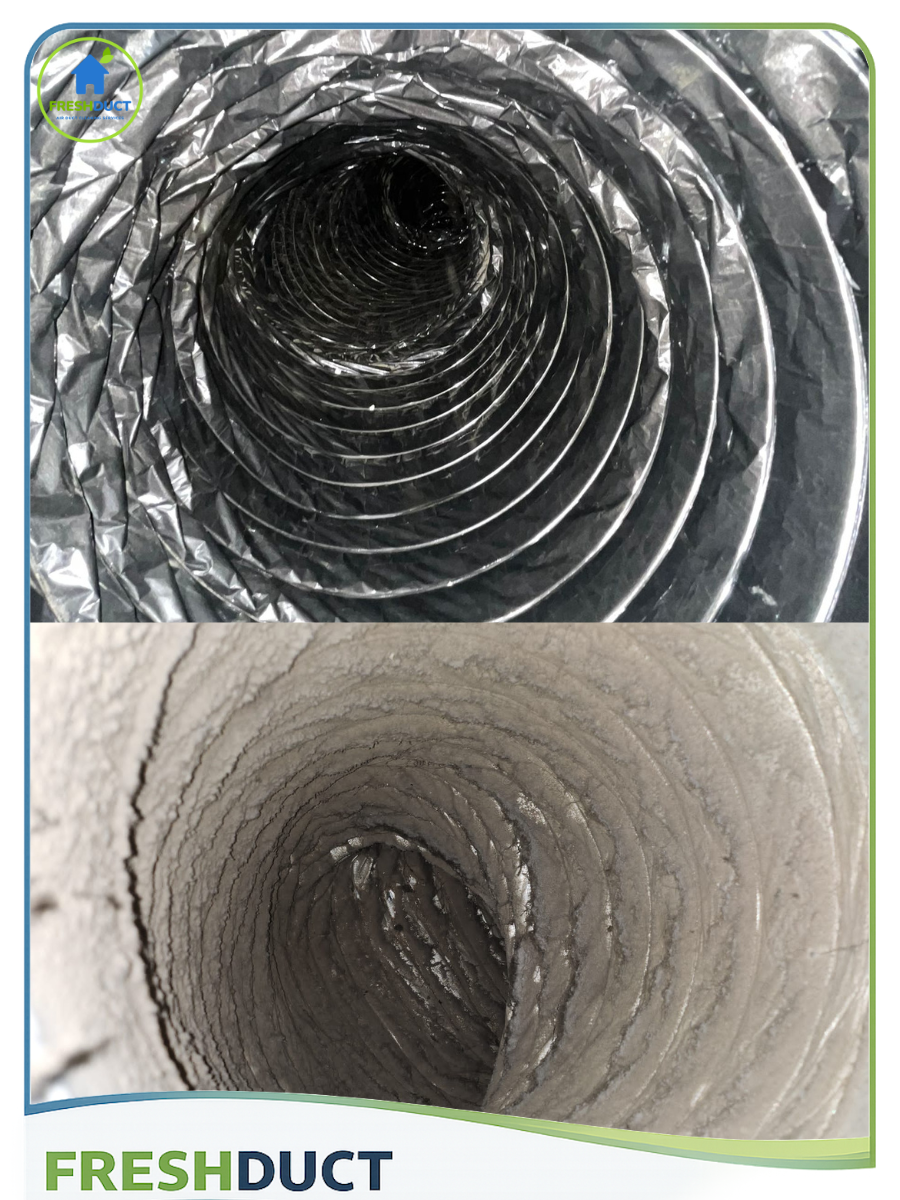


We clean the system, not the parts of it you can see. That means every supply run, every return, the grilles and diffusers, the plenum and the unit itself — mechanically brushed and extracted under negative pressure, with the debris captured rather than pushed further down the run. On underfloor systems common through Woden, Weston Creek and Belconnen, that also means lifting and clearing floor registers properly rather than vacuuming through the grille.
Then we camera it and photograph it. You get before and after images of the actual runs in your house, plus a plain-English note on anything we found that is not a cleaning problem — a disconnected duct, torn insulation wrap, a return that has never been sealed to the frame. Those findings are usually worth more than the clean itself, because they are what is costing you money every winter.
Book a Canberra Duct CleanWe clean ducted heating and cooling systems across every Canberra district — the Inner North through Braddon, Turner, Dickson, Ainslie and O’Connor; the Inner South through Kingston, Manuka, Griffith, Narrabundah, Yarralumla and Deakin; Woden and Weston Creek including Curtin, Phillip, Weston and Holder; Belconnen including Bruce and Kaleen; Gungahlin through Ngunnawal and Amaroo; and Tuggeranong including Kambah.
Tell us your suburb when you call and we can usually tell you what we expect to find before we arrive, because Canberra’s build eras are that consistent. A 1920s Inner North cottage with a retrofit system is a materially different job from a 2005 Gungahlin house with modern ceiling ducting, and we quote on which one you actually have.
A measured, documented clean of the whole system — not just the visible grilles.
Camera the runs and identify the layout, the material and the real condition.
A firm price based on what we found, before any work starts.
Drop sheets, sealed access and containment so nothing lands in your rooms.
Mechanical agitation with negative-pressure extraction, run by run.
The plenum, the return and the unit itself, not just the ducting.
Before and after images, plus anything we found that needs your attention.
Verified 5-star reviews from across FreshDuct’s duct, heating, cooling, chimney and insulation services. These are company-wide reviews from our established customer base — the same technicians and standards we bring to Canberra.
“Allen provided exceptional service — friendly, professional and went above and beyond.”
“Highly impressed with the professionalism and efficiency. On time, and no mess left behind.”
“Exceeded my expectations. Knowledgeable, meticulous and respectful of our home.”
“So glad I chose FreshDuct. Knowledgeable team and the whole process was smooth from start to finish.”
“Quick, efficient and professional — we could immediately feel the difference.”
“The technician arrived on time and was incredibly thorough — the difference at home is obvious.”
Duct cleaning pairs naturally with these Canberra services.
More often than the generic advice suggests, because Canberra systems work almost year-round. With a heating season running roughly April to October on the back of 59 sub-zero nights, and then 43 days a year at or above 30°C, a Canberra ducted system racks up run hours a mild coastal city never will. Every two to three years suits most homes; annually if you have pets, allergies, or have renovated.
Yes, and they are common in Canberra — particularly through the Woden, Weston Creek and Belconnen housing built around the town centres that opened in 1971 and 1977. Underfloor runs collect differently from ceiling ducting because everything that falls through a floor register stays there. We lift the registers, clean the full run rather than vacuuming through the grille, and photograph it.
Usually, yes — because that smell almost always comes from the ductwork rather than the unit. Dust that has settled through the off-season gets driven through the system the first time you run heat, and if there has been any condensation in a cold roof space it can carry a musty note too. Cleaning the runs, returns and plenum addresses the source rather than masking it.
In most cases, yes. The ACT has legislated to phase out fossil fuel gas by 2045 at the latest and has prevented new gas network connections since 8 December 2023, but that is a long runway and a sound system will run for years yet. Cleaning is inexpensive relative to replacement and improves what you have now. If we think your system is genuinely at end of life, we will tell you rather than sell you a clean.
All of them, across every district — Inner North, Inner South, Woden, Weston Creek, Belconnen, Gungahlin and Tuggeranong, plus Queanbeyan. Canberra is compact enough that we can usually offer a firm appointment time rather than a half-day window.
A full system clean with camera inspection and before-and-after photos. Available 7 days across the ACT.
Tell us the system type and suburb and we will come back fast.