 FreshDuct
★★★★★
“Allen provided exceptional service — friendly, professional and went above and beyond.”
JVerified
Jane
Wantirna South, VIC
Some people are using the FreshDuct name and pretending to be us to scam customers. Please don't fall for it. We are the only genuine FreshDuct, operating in Melbourne, Sydney, Adelaide and Perth. Only deal with us through freshduct.com.au, or call us directly on 04 3191 8137 or 0480 004 051. We are taking legal action against these impostors. Thank you.
Canberra’s dry summer air makes evaporative cooling genuinely effective — and its frost season is brutal on the plumbing that makes it work. FreshDuct services pads, pump, tray, float and belts, and photographs the lot.
Frost season is hard on water lines. Have it checked before the first hot week, not after.
Evaporative cooling works by passing air across wet pads, so its performance depends on how dry the incoming air is. Canberra is well suited to it. Bureau of Meteorology long-record figures for Canberra Airport put the mean 3pm temperature in January at 26.5°C against a mean 3pm dew point of just 8.6°C — a very large gap, and exactly the dry-air condition in which an evaporative unit delivers its best result. On a hot Canberra afternoon a well-serviced cooler is efficient, cheap to run and genuinely comfortable.
The problem is the other six months. A Canberra evaporative unit sits on the roof, full of water or recently drained, through a season that averages 59 nights at or below 0°C and has a lowest recorded reading of -10.0°C. Water expands when it freezes. Every season, the units we open up show the same story — split water lines, cracked float valves, seized pumps, perished seals and corroded trays that were fine in March and are not fine in November.
Then there is the pads themselves. Canberra summers are hot, with the airport averaging 43 days a year at or above 30°C and a record of 44.0°C, and hot dry air pulls a lot of water through a pad. Mineral scale builds, the pad stiffens and channels, and airflow drops through exactly the part of the unit that is supposed to be doing the cooling. A cooler that seems “not as good as it used to be” is nearly always a pad and airflow problem, not a dead machine.
Why Canberra is a great climate for evaporative cooling and a hard one for the hardware.
Everything a frost season and a hot dry summer do to an evaporative unit, in order of how often we find it.
This is the Canberra fault. With 59 nights a year at or below freezing and a record low of -10.0°C, any water left in a supply line, a float valve or a pump body has months of opportunity to freeze and expand. Hairline splits that hold under no pressure fail the moment the solenoid opens in November. We pressure-test rather than eyeball, because the leak you find in spring is cheaper than the ceiling you replace in summer.
Hot dry air pulls a lot of water through a pad, and every litre leaves its minerals behind. Over a few Canberra summers the pad stiffens, scale bridges the flutes and water starts running down channels instead of wetting the whole face. Airflow drops and so does cooling. Pads are a consumable, not a permanent part, and replacing them is usually the single biggest performance gain available.
The pump moves water to the distribution tray, the float sets the water level, and on belt drive units the belt turns the fan. All three are wear items and all three fail more often here because of the freeze and thaw. A cooler that runs the fan but blows warm is usually a pump or float problem; a cooler that is noisy or weak is usually a belt or bearing problem.
Trays corrode, seals perish and the roof penetration around the unit is a leak point that nobody inspects until there is a stain on a ceiling. We check the tray for corrosion and standing sediment, the cabinet for rust-through, and the flashing and seal where the unit meets the roof — all things a frost-and-thaw cycle accelerates.
An evaporative cooler is a ducted system, and the ductwork matters as much as the box. Collapsed or disconnected runs in the roof space, ceiling diffusers painted half shut and a house with nowhere for the air to exhaust all produce the same complaint: “it is running but nothing is happening”. Evaporative cooling needs open windows or vents to work, which is the single most misunderstood thing about it.
Six months idle on a Canberra roof means leaf litter, dust, insects and sometimes nests inside the cabinet and on the pads. Starting a unit in that condition pushes all of it into the house on the first hot day, which is the smell people describe as the cooler “going musty”. An early service clears it before it gets distributed through the ducting.
Real FreshDuct evaporative cooler service and repair work, photographed on every job.
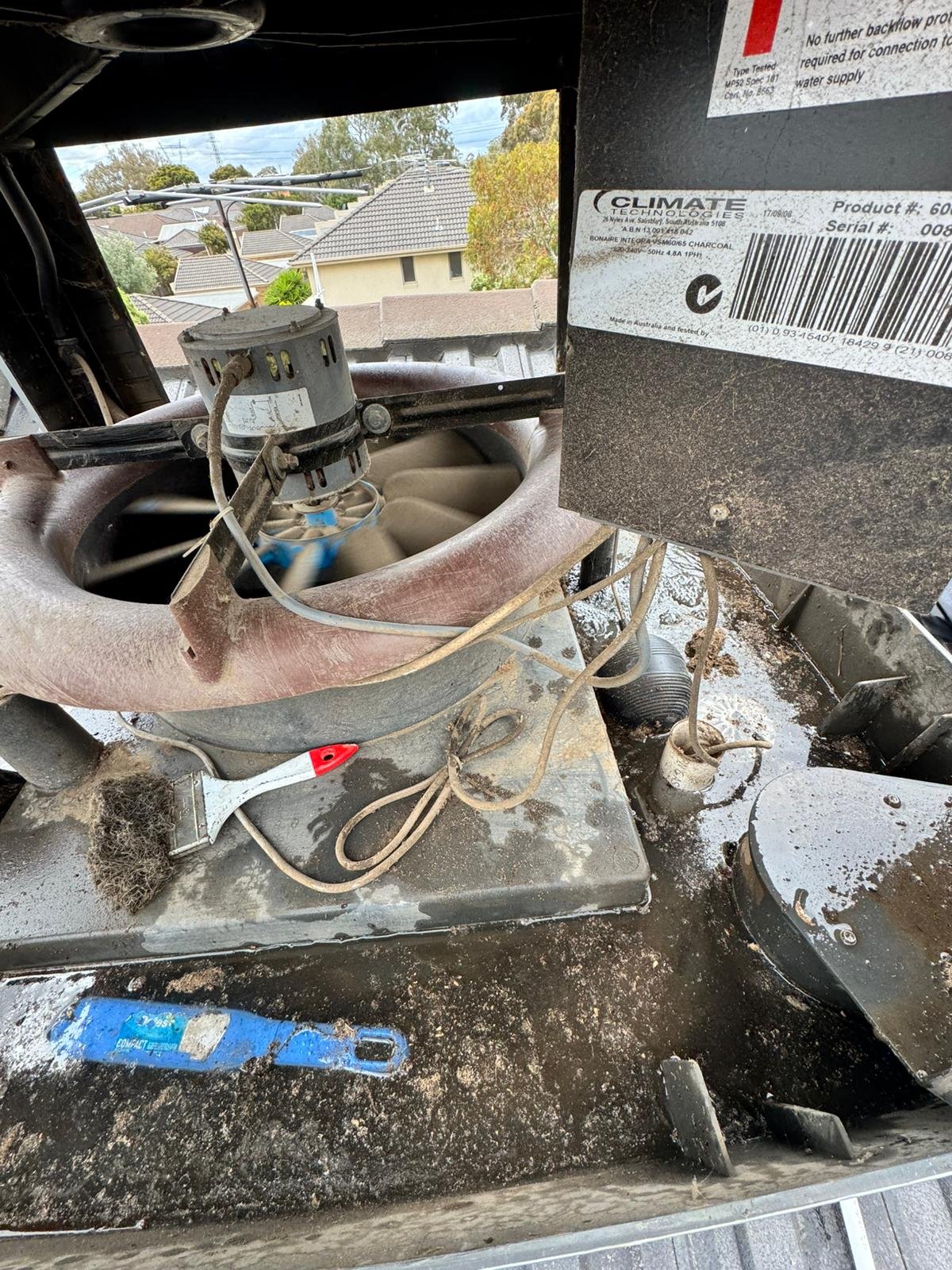
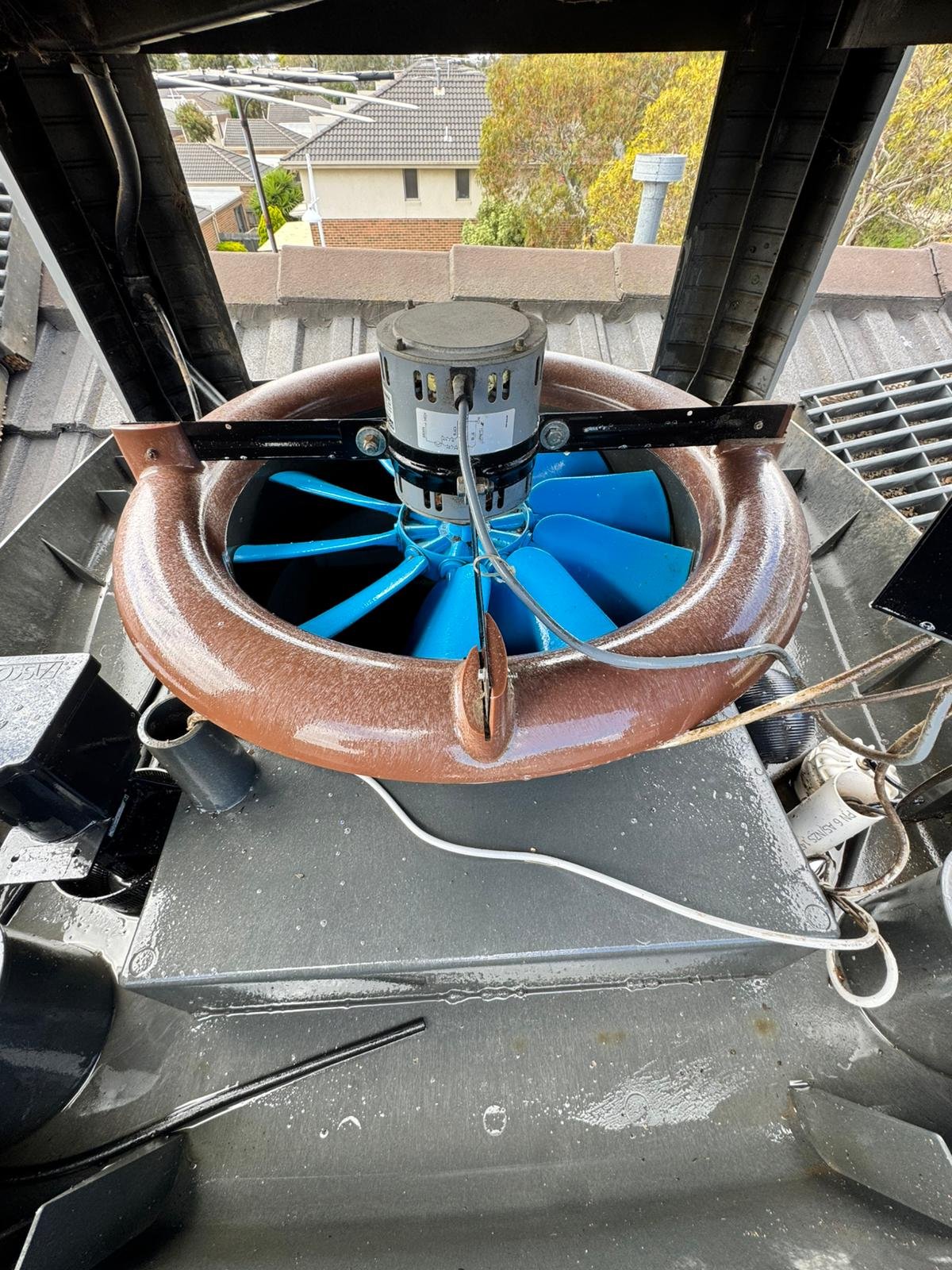
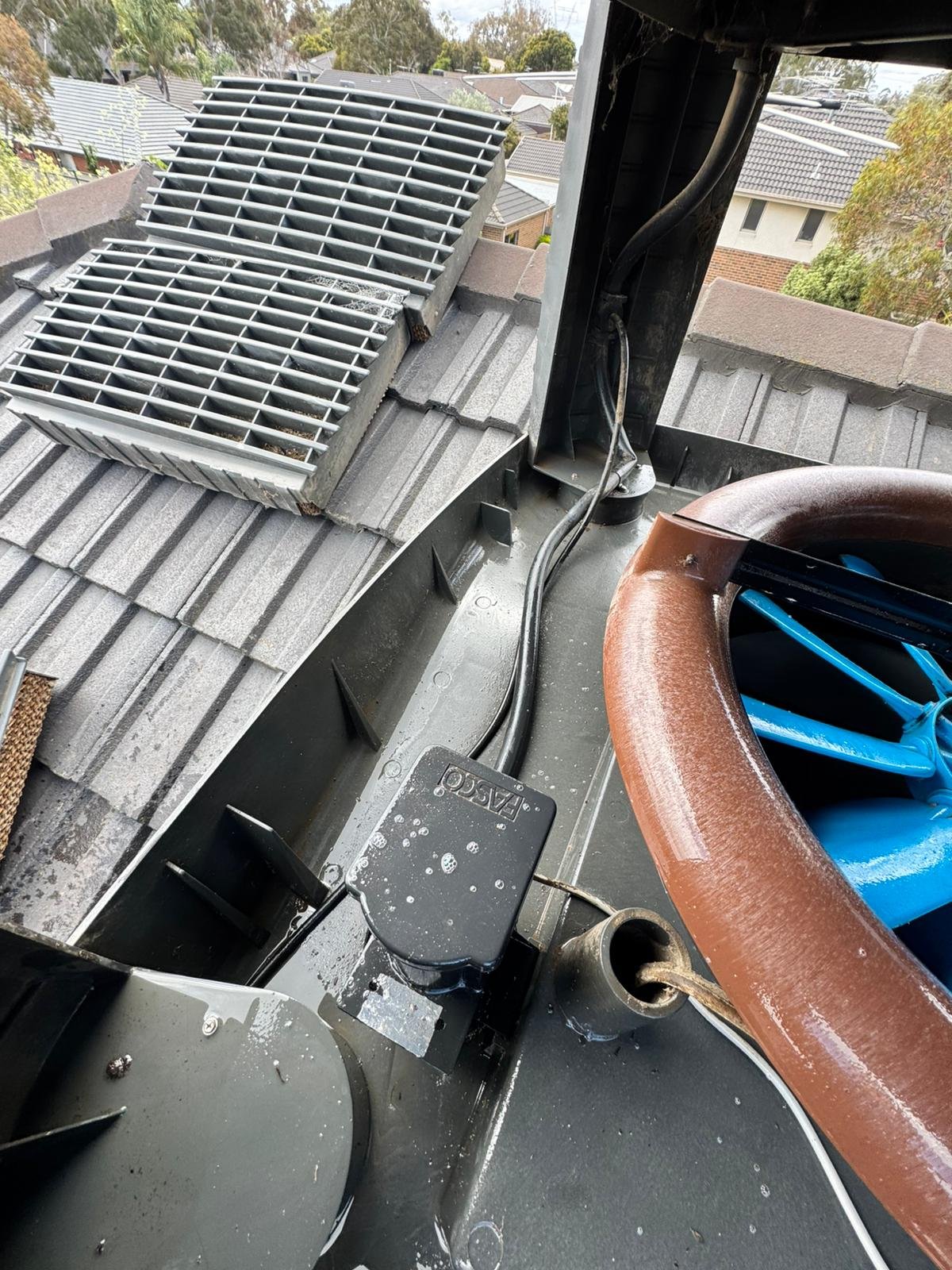
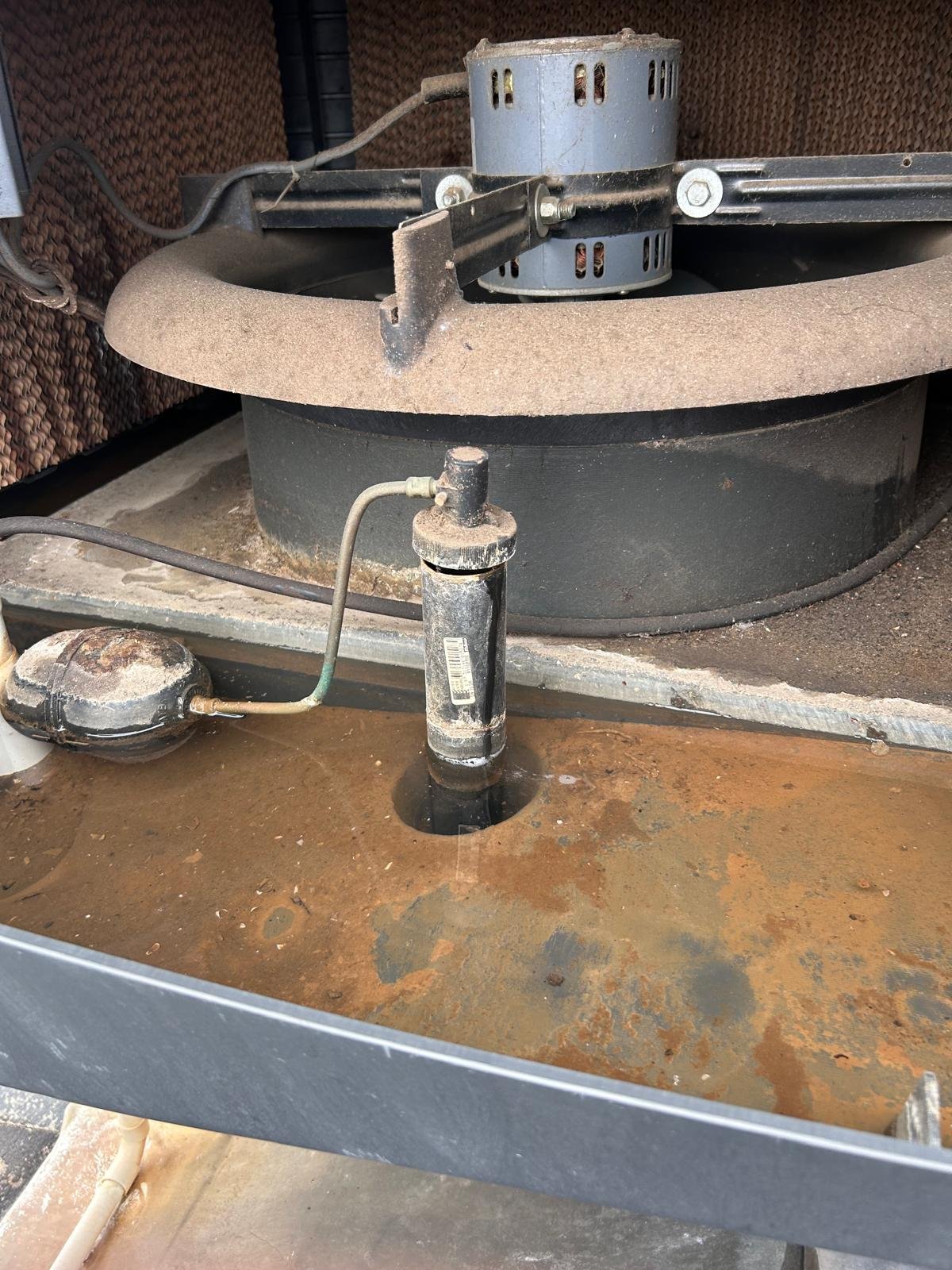
A full service means the cabinet opened, the pads assessed and replaced if they are scaled or channelled, the tray drained and cleaned back, the pump tested under load, the float valve set correctly, belts and bearings checked, and the water lines pressure-tested for the freeze damage a Canberra winter causes. We also look at the ducting and diffusers downstream, because a perfect cooler feeding collapsed ductwork is still a cold house on paper only.
You get before and after photos of your own unit, a clear list of what was replaced and what was left alone, and a plain answer on where the unit is in its life. Evaporative units are straightforward machines and most of them are worth repairing. When one genuinely is not, we say so rather than selling you a service that will not last the summer.
Book a Cooler ServiceWe service and repair evaporative coolers across every Canberra district — the Inner North through Braddon, Turner, Dickson, Ainslie and O’Connor; the Inner South through Kingston, Griffith, Narrabundah, Yarralumla and Deakin; Woden and Weston Creek including Curtin, Phillip, Weston and Holder; Belconnen including Bruce and Kaleen; Gungahlin through Ngunnawal and Amaroo; and Tuggeranong including Kambah. Queanbeyan included.
Evaporative units are especially common through the detached housing built out around the town centres that opened at Woden in 1971, Belconnen in 1977 and Tuggeranong in 1987, where roof access is straightforward and the ducting was designed for it. Spring is the right time to book — before the first hot week, when a freeze-damaged water line is a scheduled repair rather than an emergency.
Opened, assessed, repaired and tested — before the hot weather, not during it.
Cabinet opened and every component inspected and photographed.
Assessed for scale and channelling, replaced where they have stopped performing.
Tray cleaned, pump tested under load, float set, lines pressure-tested.
Belts, bearings and fan balance checked and adjusted.
Ducting, diffusers and exhaust path checked so the air actually arrives.
Run under load, with before and after photos and a clear parts list.
Verified 5-star reviews from across FreshDuct’s duct, heating, cooling, chimney and insulation services. These are company-wide reviews from our established customer base — the same technicians and standards we bring to Canberra.
“Allen provided exceptional service — friendly, professional and went above and beyond.”
“Highly impressed with the professionalism and efficiency. On time, and no mess left behind.”
“Exceeded my expectations. Knowledgeable, meticulous and respectful of our home.”
“So glad I chose FreshDuct. Knowledgeable team and the whole process was smooth from start to finish.”
“Quick, efficient and professional — we could immediately feel the difference.”
“The technician arrived on time and was incredibly thorough — the difference at home is obvious.”
Cooler servicing pairs naturally with these Canberra services.
Yes, and better than in most Australian capitals, because the mechanism depends on dry air. Bureau of Meteorology figures for Canberra Airport show a mean 3pm January temperature of 26.5°C against a mean 3pm dew point of only 8.6°C. That large gap is precisely the condition in which an evaporative unit performs well. Kept serviced, it is efficient and cheap to run through an ACT summer.
Spring, before the first hot week. The reason is specific to the ACT: your cooler has just sat through a season averaging 59 nights at or below 0°C, and freeze damage to water lines, float valves and pumps is the single most common fault we find. Discovering a split line in September is a scheduled repair. Discovering it in a heatwave is an emergency with a waiting list.
Most often the pads. Hot dry Canberra air pulls a lot of water through them and the minerals stay behind, so over a few summers the pad scales up, stiffens and lets water channel down one path instead of wetting the whole face. Airflow and evaporation both drop. The other common causes are a failed pump, a float set too low, and windows shut — evaporative cooling needs an exhaust path to work at all.
It is a sensible habit here in a way it is not in warmer cities, because standing water in lines and valves is exactly what freezes and splits. Many units have a drain function for this. Even so, we still pressure-test the water system at the spring service, because a line can hold through a drained winter and fail under mains pressure the first time the solenoid opens.
Usually. Evaporative units are simple machines and the common Canberra failures — pads, pump, float valve, belt, a split water line — are all replaceable parts rather than terminal faults. Where the tray has corroded through or the cabinet has rusted out, that is a different conversation and we will tell you plainly rather than servicing something that will not see out the summer.
Pads, pump, tray, float, belts and water lines — serviced, tested and photographed before the heat arrives. Available 7 days.
Tell us what it is doing and which suburb you are in.