 FreshDuct
★★★★★
“Allen provided exceptional service — friendly, professional and went above and beyond.”
JVerified
Jane
Wantirna South, VIC
Some people are using the FreshDuct name and pretending to be us to scam customers. Please don't fall for it. We are the only genuine FreshDuct, operating in Melbourne, Sydney, Adelaide and Perth. Only deal with us through freshduct.com.au, or call us directly on 04 3191 8137 or 0480 004 051. We are taking legal action against these impostors. Thank you.
Canberra is dry, and Canberra still gets mould — because the mechanism here is condensation, not humidity. FreshDuct finds the moisture source, treats the growth properly, and tells you what to change so it does not come back.
If it comes back in the same spot every winter, the cleaning was never the problem.
People are genuinely surprised to find mould in a Canberra house, because Canberra does not feel humid. That instinct is right about the climate and wrong about the mechanism. Mould needs a surface that stays damp, and the way a surface stays damp in the ACT is not airborne humidity — it is condensation, driven by the difference between a heated interior and a genuinely cold exterior.
The Bureau of Meteorology numbers make the size of that gap clear. Canberra Airport averages 59 nights a year at or below 0°C and 92 days at or below 2°C, and the July mean daily maximum is only 11.4°C, so the cold does not lift much during the day either. Hold a house at 20°C against that and every poorly insulated wall junction, every single-glazed window reveal, every uninsulated corner and every cold spot behind a wardrobe becomes a condensing surface. Moisture arrives there from showers, cooking, drying clothes indoors and simply breathing, and it has nowhere to go because the house is sealed shut.
The other thing that catches people out is that there is no dry season to reset it. Canberra’s 616 mm of annual rain is spread right across the calendar — the wettest month averages about 64 mm and the driest about 41 mm — so unlike the winter-rainfall capitals, the ACT never gets a long dry stretch that dries a problem out on its own. Whatever is wet stays wet until something changes.
Why a dry, cold city produces mould, and where the water actually comes from.
We diagnose the moisture source before we treat anything, because treating growth without fixing the cause just buys you a season.
This is the dominant Canberra mechanism. Wall junctions, window reveals, external corners and the wall behind a wardrobe or against an unheated room all sit colder than the air in the room. Moist indoor air reaches them, condenses, and stays. It shows up as the classic pattern — growth in corners, along the top of external walls and around windows, worse in the rooms you heat least.
From April to October a Canberra house is sealed. Every shower, every load of washing dried inside, every pot on the stove adds moisture that in a warmer city would leave through an open window. Here it circulates until it finds a cold surface. Underperforming bathroom and laundry fans are the single most common contributing fault we find, and often the cheapest to fix.
A cold roof space over a warm house is a condensation trap, and Canberra has the coldest roof spaces in the country — the mean daily ground minimum in July is around -2.8°C. Where warm moist air leaks up through ceiling penetrations, or where an exhaust duct discharges into the cavity instead of outside, it condenses on cold framing and wets the insulation. Wet insulation stops insulating, the ceiling gets colder, and the problem accelerates.
Pre-war housing in the Inner North and Inner South — Braddon from 1921-22, Reid from 1926-27 — and the brick-veneer stock built out around the 1971 and 1977 town centres were not designed for a modern heated interior. Solid masonry, minimal wall insulation and single glazing all create cold surfaces on the inside face. That is not a defect to be scandalised by; it is a condition to be managed.
Once the source is understood, the remediation itself has to be done correctly — containment so spores are not spread through the house, HEPA extraction, appropriate treatment of the affected surfaces, and honesty about materials that cannot be salvaged. Painting over mould, or wiping it with household bleach, reliably produces the same problem in the same place next winter.
Almost every Canberra mould job ends with the same short list: get the extraction working, stop the moisture reaching the cold surface, and warm the surface up if you can. That usually means a fan repair, a duct correction, a ceiling insulation fix, or simply changing how a room is used and heated. We tell you which of those applies to your house, and we would rather you spend the money there than on repeat cleaning.
Real FreshDuct mould and moisture work, photographed before and after.

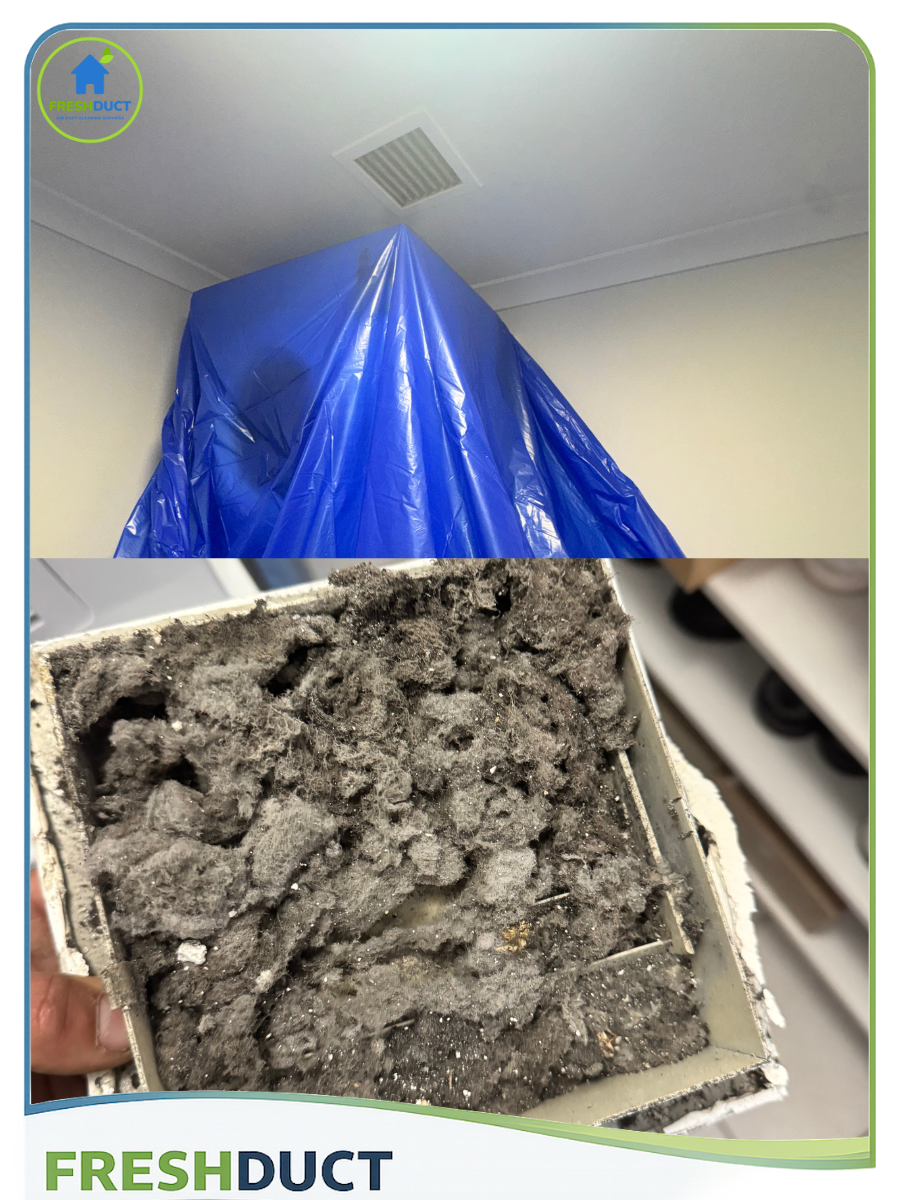

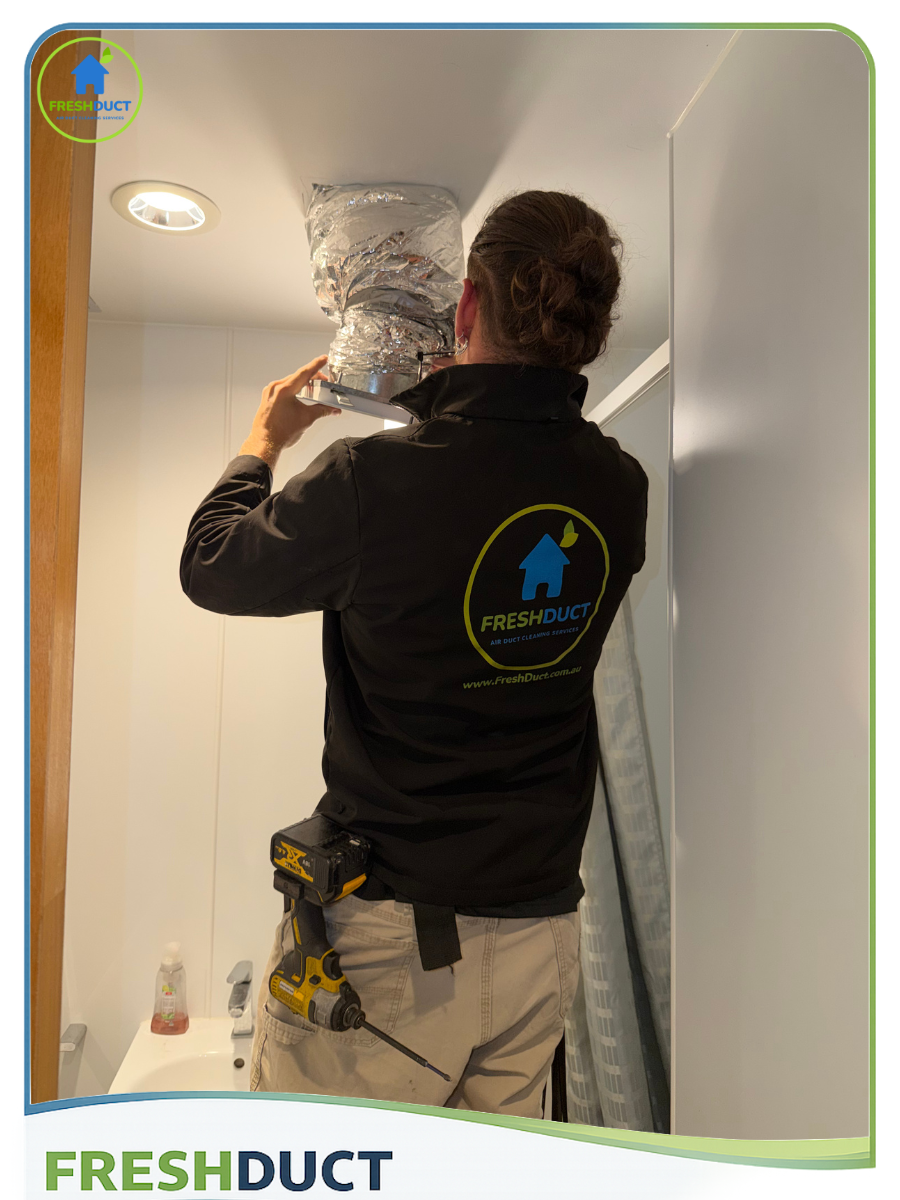
We start with the water, not the stain. Where is the moisture coming from, what surface is cold enough for it to condense on, and why is it not being removed? That means looking at the extraction fans and their duct runs, the ceiling insulation and any roof-space condensation, the construction and glazing of the affected wall, and how the room is actually heated and used. The answer is nearly always in that list, and it is nearly always fixable.
Then the remediation: containment so nothing is spread through the rest of the house, HEPA extraction, proper treatment of affected surfaces, and a straight word about anything — saturated plasterboard, ruined insulation — that genuinely needs to be removed rather than cleaned. You get before and after photographs and a short, specific list of what to change. If the underlying cause is beyond our scope, we will say that too rather than treating the symptom and taking the money.
Book a Mould AssessmentWe assess and treat mould across every Canberra district — the City and Inner North through Braddon, Turner, Dickson, Ainslie and O’Connor; the Inner South through Kingston, Manuka, Griffith, Narrabundah, Yarralumla and Deakin; Woden and Weston Creek including Curtin, Phillip, Weston and Holder; Belconnen including Bruce and Kaleen; Gungahlin through Ngunnawal and Amaroo; and Tuggeranong including Kambah. Queanbeyan included.
The pattern shifts with build era, which in a planned city is unusually predictable. Pre-war Inner North and Inner South stock tends to show thermal-bridging mould at wall junctions and window reveals. The 1970s and 1980s housing around Woden, Belconnen and Tuggeranong more often shows ceiling and roof-space condensation. Apartments across the City, Braddon, Kingston and Gungahlin are usually a ventilation problem in a windowless bathroom. Tell us the suburb and the location of the growth and we will usually have a strong idea before we arrive.
Diagnose the moisture, contain the area, treat it properly, then fix the cause.
Find the moisture source and the cold surface before anything is treated.
Show you what is causing it, with photos, in plain English.
Seal the work area so spores are not distributed through the house.
HEPA extraction and appropriate treatment of the affected surfaces.
Honest advice on saturated materials rather than covering them.
Extraction, ducting or insulation corrected so it does not return.
Verified 5-star reviews from across FreshDuct’s duct, heating, cooling, chimney and insulation services. These are company-wide reviews from our established customer base — the same technicians and standards we bring to Canberra.
“Allen provided exceptional service — friendly, professional and went above and beyond.”
“Highly impressed with the professionalism and efficiency. On time, and no mess left behind.”
“Exceeded my expectations. Knowledgeable, meticulous and respectful of our home.”
“So glad I chose FreshDuct. Knowledgeable team and the whole process was smooth from start to finish.”
“Quick, efficient and professional — we could immediately feel the difference.”
“The technician arrived on time and was incredibly thorough — the difference at home is obvious.”
Mould work pairs naturally with these Canberra services.
Because mould responds to wet surfaces, not to how humid the air feels. In the ACT the water arrives by condensation: a house held at 20°C against 59 sub-zero nights a year and a July mean daily maximum of only 11.4°C has cold surfaces at wall junctions, window reveals and external corners. Moisture from showers, cooking and drying clothes indoors condenses there and stays, because the house is sealed for the winter.
Because the cleaning was never the fix. Recurring growth in a consistent location means the moisture source and the cold surface are both still there, and treating the visible growth just resets the clock. We diagnose the source first — usually underperforming extraction, a duct discharging into the roof space, wet or missing insulation, or an untreated thermal bridge — and fix that alongside the remediation.
It is not a real solution and it can make things harder. Household bleach may lighten the staining on a non-porous surface while leaving the growth in porous material underneath, so the problem looks solved and returns. It also does nothing at all about the moisture that caused it. Proper remediation means containment, HEPA extraction and appropriate treatment, followed by fixing the water.
Underperforming extraction, by a clear margin. Bathroom and laundry fans that are packed with dust, running into a sagging or disconnected duct, or discharging into the roof space instead of outside. In a city where the house is shut from April to October, that fan is the only thing removing moisture, and when it underperforms the water has to go somewhere.
Both, and we will not do the second without addressing the first. Most Canberra causes fall within what we do anyway — exhaust fan repair, duct correction, ceiling insulation. Where the underlying issue is outside our scope, such as a structural leak or rising damp, we will tell you plainly and point you at the right trade rather than treating a symptom we know will return.
Source diagnosed, growth treated properly, cause fixed — with photos and a short list of what to change. Available 7 days across the ACT.
Tell us where the growth is and how long it has been there.