★★★★★
“Allen provided exceptional service — friendly, professional and went above and beyond.”
J
Jane
Wantirna South, VIC
Verified

On a Ringwood roof the terminal is where the gum litter lands, where the embers leave and where cold air sinks into the flue on a still night. FreshDuct fits guards, spark arrestors and cowls that deal with all three, and photographs them from the roof.
Fire draws badly only on still, cold nights? That is the terminal, and a cowl or extra height fixes it.
Ask why a Ringwood heater has stopped drawing and the answer is on the roof more often than in the flue. Mature eucalypts drop leaf and strips of bark onto the terminal all year, and an open or coarsely meshed cowl lets it in, where it sits on the baffle and smoulders the first time the fire is lit. The right guard has mesh fine enough to stop bark ribbons and enough free area not to choke the flue itself.
The same trees make the terminal an ember question. A slow-combustion fire burning hard on a foothills night can carry sparks up the flue, and a roof and gutters carrying gum litter are exactly where you do not want them to land. A spark arrestor holds embers in the flue, and on a Ringwood block with branches over the roof it is the fitting we would choose before any other.
Then there is the draw itself. On still, cold nights near the ranges, cold air pools and can sink down a flue whose terminal sits too low against the roof or a nearby tree line, so the fire smokes on the calmest evenings of the year. Where clearing the terminal of litter does not fix it, we look at cowl type and terminal height, test the draw with the change made, and photograph the finished terminal from the roof.
Spark arrestors, litter guards and cowls for wood heater flues on Ringwood’s treed blocks, with terminal height looked at where the draw needs it.
Gum leaf and bark ribbons find their way through a coarse guard and pack the terminal by mid-autumn. We fit a guard with mesh sized to stop them while keeping enough open area for the flue to breathe, and clear what is already in there.
A hard-burning Ringwood heater can throw sparks from an open terminal onto a roof holding dry leaf and bark. A spark arrestor keeps them in the flue, and on a block with branches overhead it is not an optional extra.
When cold air settles over the foothills on a windless night it can sink down a low terminal and push smoke into the room. The fix is a cowl suited to it or more terminal height, and we test the draw rather than assume.
Real photos from Melbourne jobs — not stock, not staged.


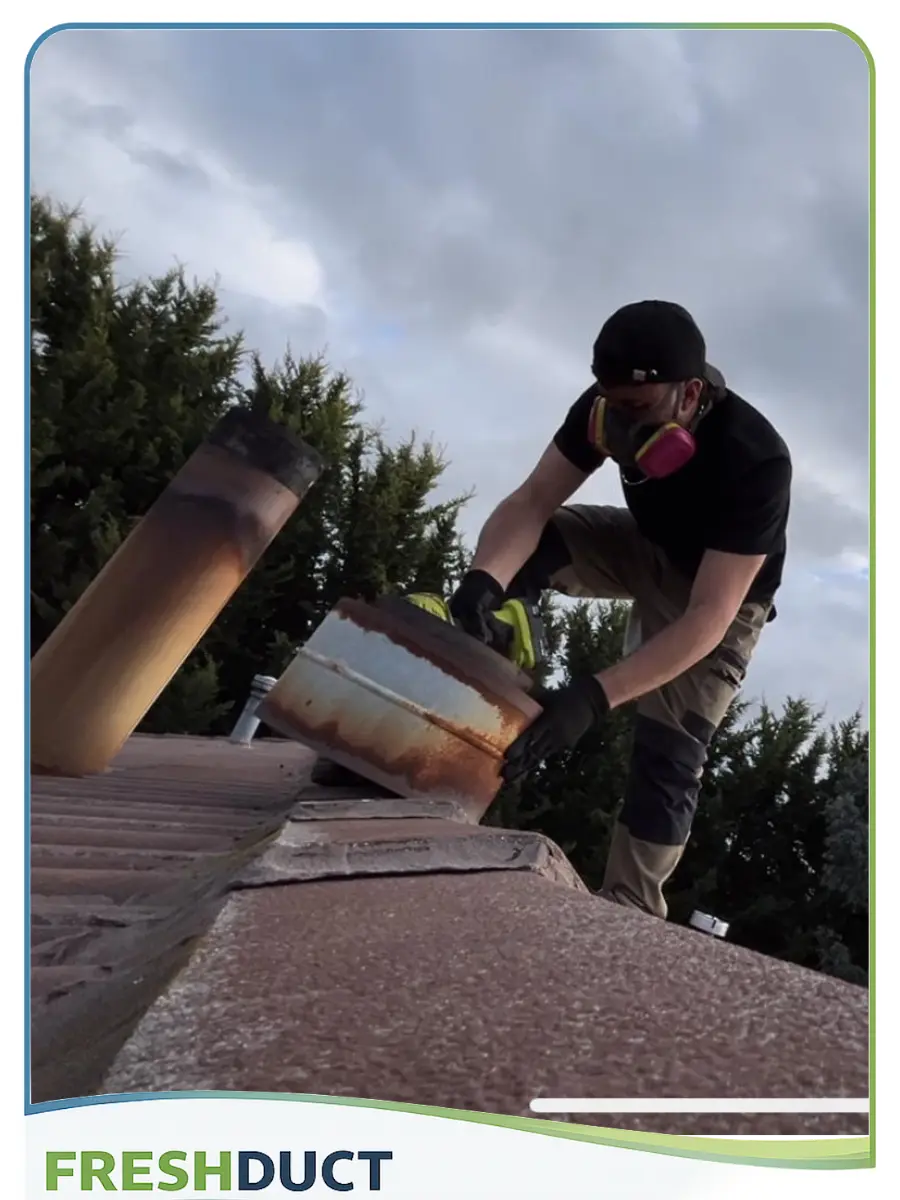
The measure of a Ringwood terminal is a still, cold night with the gums dropping litter, not a mild afternoon. So we fit the guard, arrestor or cowl from the roof, then run the heater and check the draw with the fitting in place before we call it done.
You get a photo of the finished terminal from the roof, and if the block is steep or the tiles brittle, we have planned how to get up there before the day rather than finding out on it.
Documented end to end — every job, every suburb.
Flue size, terminal type and roof access checked.
The right cap or cowl for the appliance and the problem.
Firm price before any work.
Fixed and sealed from the roof, safely.
Draw checked with the cap on.
A photo of the finished cap from the roof.
Verified 5-star reviews from across FreshDuct’s duct, heating, cooling and chimney services.
“Allen provided exceptional service — friendly, professional and went above and beyond.”
Verified
“Highly impressed with the professionalism and efficiency. On time, and no mess left behind.”
Verified
“Exceeded my expectations. Knowledgeable, meticulous and respectful of our home.”
Verified
“So glad I chose FreshDuct. Knowledgeable team and the whole process was smooth from start to finish.”
Verified
“Quick, efficient and professional — we could immediately feel the difference.”
Verified
“The technician arrived on time and was incredibly thorough — the difference at home is obvious.”
Verified
The same local team covers the suburbs around Ringwood. Explore nearby areas and related FreshDuct chimney services.
Often, yes. When cold air pools on a windless night it can sink into a terminal that sits low against the roof line, and raising the terminal or fitting a cowl built for downdraught lets the flue draw. We clear the terminal first, since litter is the cheaper cause, then test the draw with the change made.
A terminal guard with mesh fine enough to stop bark ribbons and leaf but with enough open area that the flue still breathes; too fine and it chokes the fire, too coarse and the litter walks straight through. We match it to the flue and the trees over it, clear the terminal before fitting, and photograph it in place.
An open flue lets rain, leaves and birds straight in. A cap keeps the flue dry, keeps nests out and, on a wood heater, a spark arrestor stops embers leaving the flue.
Usually a downdraught — wind pushing back down the flue. An anti-downdraught cowl is the normal fix; we confirm the draw with a test before and after.
Yes. If we are on the roof for a sweep and the flue needs a cap, we can quote it on the spot and fit it the same visit where we have the right size.
Send your details and the office confirms a window for Ringwood. No call-out fee, before and after photos, and honest advice on what your chimney needs and what it does not.