 FreshDuct
★★★★★
“Allen provided exceptional service — friendly, professional and went above and beyond.”
JVerified
Jane
Wantirna South, VIC
Some people are using the FreshDuct name and pretending to be us to scam customers. Please don't fall for it. We are the only genuine FreshDuct, operating in Melbourne, Sydney, Adelaide and Perth. Only deal with us through freshduct.com.au, or call us directly on 04 3191 8137 or 0480 004 051. We are taking legal action against these impostors. Thank you.
FreshDuct services Cheminees Philippe cast iron fireplaces across Melbourne. Cast iron is a different material from folded steel, and it fails in different ways that need looking for specifically.
Cast iron does not warp like steel. It cracks — and a hairline crack is easy to miss.
Cheminees Philippe makes cast iron fireplaces in France and the brand has been available in Australia for more than three decades, long associated with Wignells. These are architectural slow combustion appliances, and they are built from a fundamentally different material from the folded and welded steel that most Australian-made heaters use. That difference should change how they are serviced, and frequently does not.
Cast iron is hard, dense and dimensionally stable at temperature, which is exactly why it is used: a cast firebox holds its shape and radiates beautifully over decades. It is also comparatively brittle. Where a steel firebox subjected to repeated overheating will distort, bow and eventually burn through, a cast iron one will absorb the thermal stress until something cracks. The crack is often fine, often in a corner or around a casting boss, and it is easy to walk past if you are only looking for the failure modes steel shows.
Cast appliances are also assembled rather than welded. Panels are bolted or keyed together and the joints between them are made with refractory stove cement and rope. Those joints are consumables. Cement dries out, shrinks and falls away over years of heat cycling, and once a joint has opened the appliance is drawing air where it should not, which upsets the air controls and can let combustion products escape into the room.
So the inspection is genuinely different. We go over the castings looking for hairline cracking at corners, around the door aperture and at any casting change of section, and we check every panel joint for open or missing cement. Both are repairable when found early. Both get considerably more expensive, and on an imported appliance considerably slower to source parts for, once they have been ignored for a few seasons.
Manufacturer and distributor published facts only. No model specifications we could not source.
The failure modes that belong to cast iron rather than steel.
Cast iron takes thermal stress until it cracks rather than distorting first. We inspect the castings closely at corners, around the door aperture and wherever the section changes thickness, because that is where cracks start. Found early, many are manageable. Ignored, a crack propagates every time the appliance is heated.
Cast appliances are assembled from panels bedded together with refractory cement and rope. Those joints dry out, shrink and open over years of heat cycling. An open joint means uncontrolled air, unpredictable burning and a possible path for combustion products into the room. We check every accessible joint and report on its condition.
A cast door carries its glass in a machined or cast recess with a gasket, and the whole assembly moves slightly with temperature. We check the glass, the gasket and the fit of the door in its frame, and look specifically for cracking radiating from the aperture corners, which is a classic cast iron location.
This matters practically. Consumables such as rope and ceramic glass we can generally source and fit. A model-specific cast component on an imported appliance may need to come through the Australian distributor and can take time. We identify what is needed early in the season rather than in the middle of winter, which is the whole argument for a pre-season service.
Whether the firebox is lined with refractory or burns directly on the casting depends on the model. We inspect the lining and the grate for cracking, erosion and burn-through, and photograph the condition so you can see it rather than take our word for it.
FreshDuct recommends an annual sweep and service before the season, and on a cast iron appliance we would argue that is a firm minimum rather than a suggestion. Early detection of a hairline crack or an opening joint is worth a great deal more on an imported appliance than it is on one whose parts are on a shelf in Melbourne.
Real FreshDuct chimney and fireplace photography. Captions describe the work only, not any particular brand of appliance.
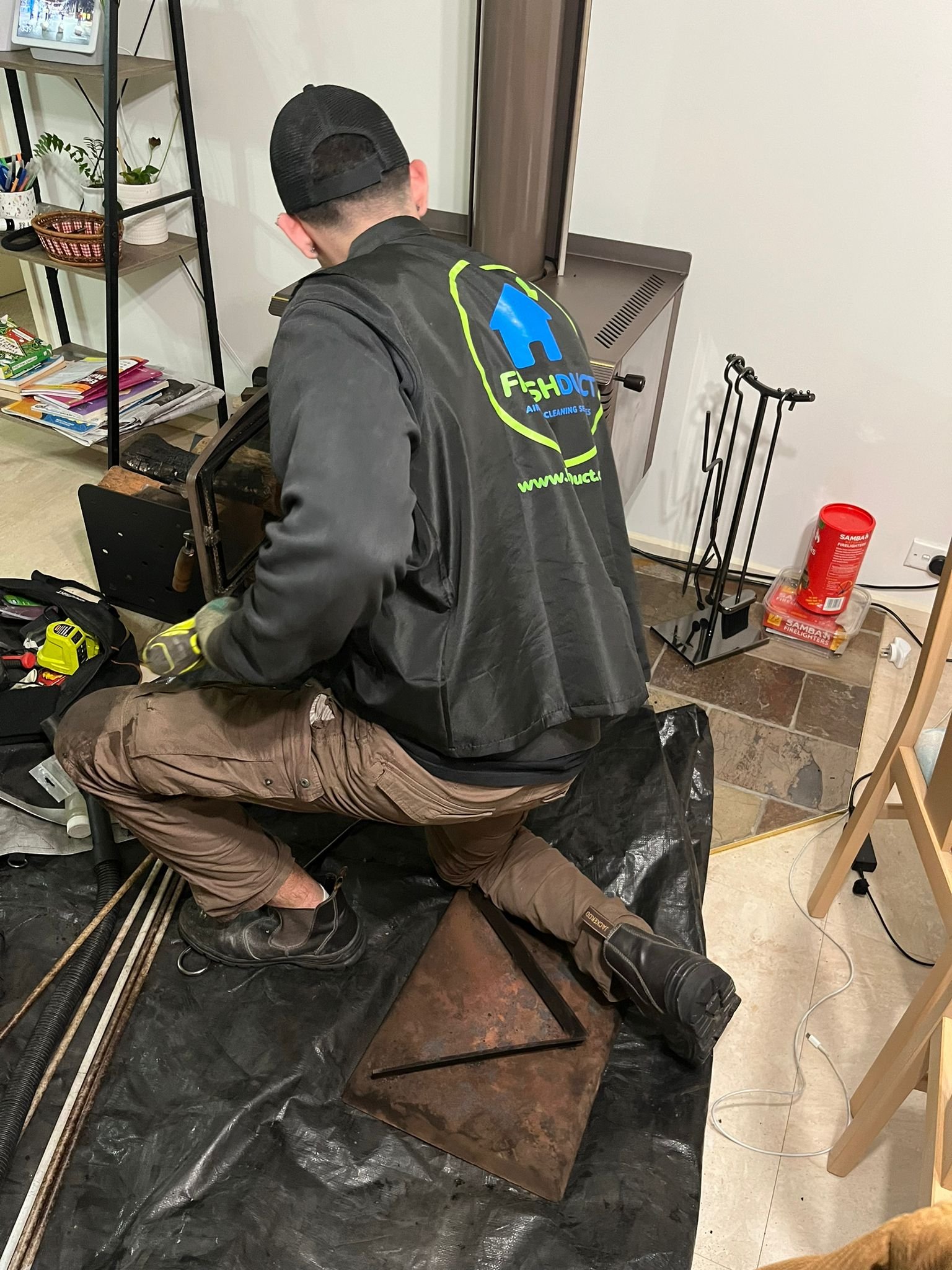
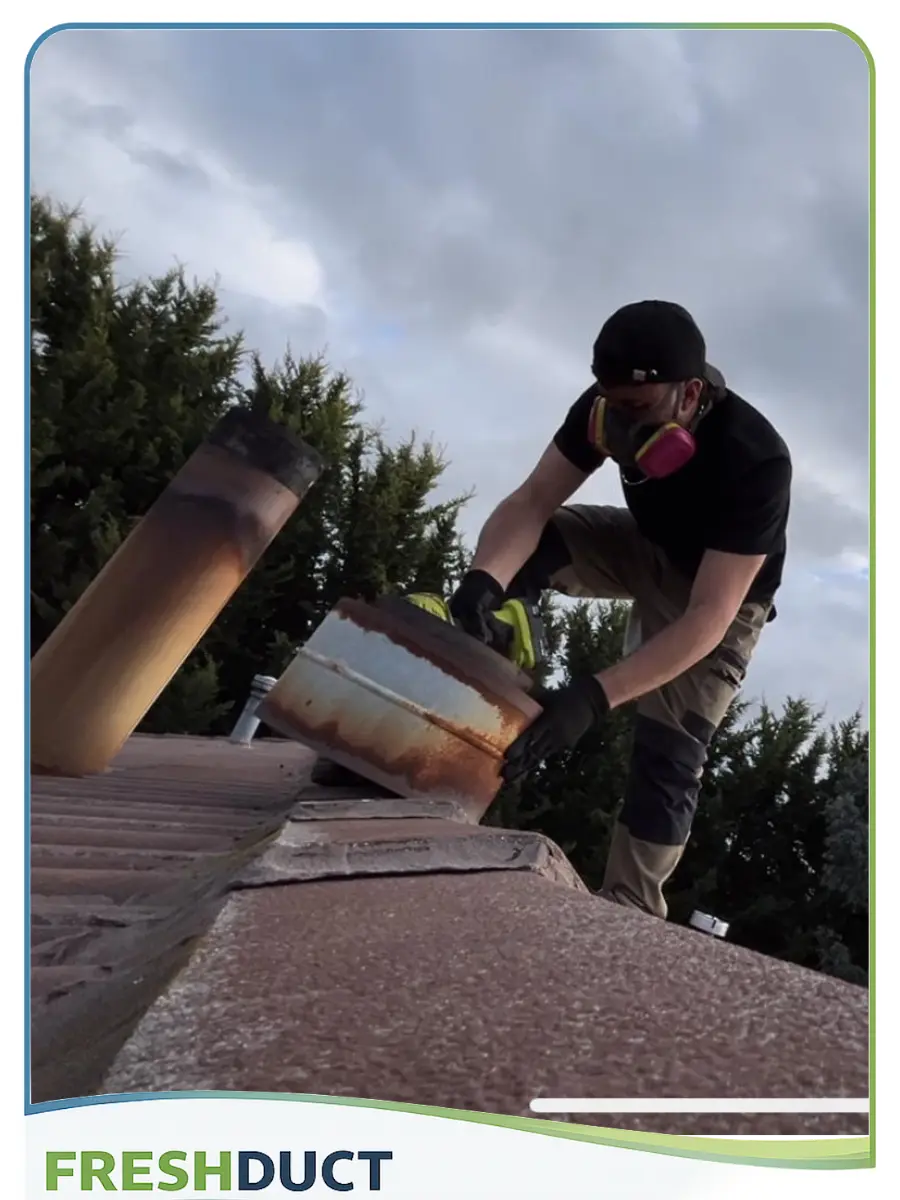
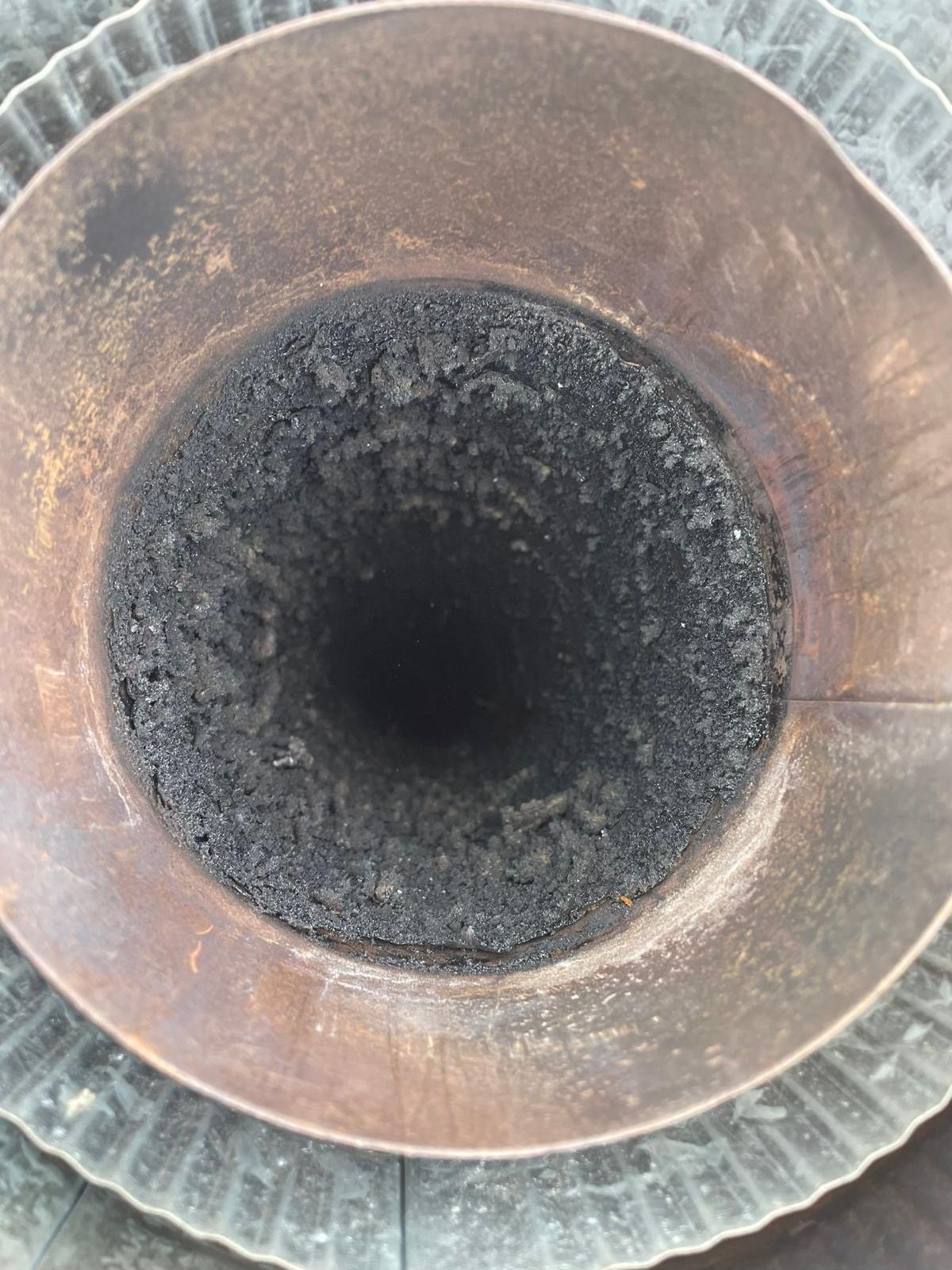
On a Cheminees Philippe we sweep the flue, clean the firebox, inspect every accessible casting for cracking, check the panel joints and stove cement, inspect the door, glass and gasket, and assess the flue and terminal from the roof where access is safe. Everything photographed and reported.
We fit suitable consumables such as rope gasket, refractory cement and ceramic glass, and we name exactly what we have used. We do not claim to supply genuine branded castings. FreshDuct has no affiliation with Cheminees Philippe or its Australian distributor and is not an agent for either — model-specific cast components and warranty matters go through the distributor, and we will tell you when that is the right path.
Book a Cheminees Philippe ServiceWe service these appliances across Melbourne, and they cluster where architect-designed and renovated homes do: Kew, Hawthorn, Camberwell, Malvern, Balwyn, Brighton, Carlton, Fitzroy and the inner-city terraces, along with substantial homes through Eltham, Warrandyte and the Yarra Valley.
A number are installed in genuinely notable rooms, and we work accordingly — full containment, careful protection of surrounding finishes, and no shortcuts around expensive stonework or joinery. The appliances themselves reward proper servicing, because a well maintained cast iron fireplace has a very long life indeed.
A cast iron inspection, not a steel one.
These sit in finished rooms. Containment and covering go up first.
Full length swept mechanically with debris captured at source.
Ash and deposit removed, lining and grate exposed for inspection.
Corners, apertures and section changes checked for hairline cracks.
Panel joints and stove cement assessed and repointed where needed.
Photos, condition note, and honest advice on any part lead times.
Verified 5-star reviews from across FreshDuct’s chimney, fireplace, duct, heating and insulation services. These are company-wide reviews from our Melbourne customer base — not reviews of any particular appliance brand.
“Allen provided exceptional service — friendly, professional and went above and beyond.”
“Highly impressed with the professionalism and efficiency. On time, and no mess left behind.”
“Exceeded my expectations. Knowledgeable, meticulous and respectful of our home.”
“So glad I chose FreshDuct. Knowledgeable team and the whole process was smooth from start to finish.”
“Quick, efficient and professional — we could immediately feel the difference.”
“The technician arrived on time and was incredibly thorough — the difference at home is obvious.”
What these installations most often need alongside a service.
It depends entirely on where the crack is, how long it is and whether it passes through the section. Some hairline cracks in non-critical areas are stable and can be monitored. A crack through a firebox panel is a different matter and generally means replacing the casting. We photograph it and give you a straight assessment rather than a guess.
It is the refractory compound bedding the cast panels together. Heat cycling dries and shrinks it until joints open, which lets uncontrolled air into the firebox and can allow combustion products out. Repointing an open joint is routine maintenance on a cast appliance and is far cheaper than dealing with the consequences of leaving it.
Consumables such as rope, refractory cement and ceramic glass are generally straightforward. Model-specific cast components usually come through the Australian distributor and can take time. That is the practical reason we push for a pre-season service, so anything needed is identified in autumn rather than mid-winter.
No. FreshDuct is an independent chimney and fireplace service company with no affiliation to Cheminees Philippe or its Australian distributor. We clean, sweep, inspect and service the appliance and its flue. Warranty work and manufacturer castings go through the distributor.
The flue sweeping itself is the same work. What differs is the inspection: on cast iron we are looking for cracking and open panel joints rather than the bowing, distortion and burn-through that steel shows. A technician only looking for steel failure modes will walk past a hairline crack in a casting.
Cast iron inspected properly, joints checked and repointed, flue swept and everything photographed.
Tell us the model and roughly the age of the installation.