★★★★★
“Allen provided exceptional service — friendly, professional and went above and beyond.”
J
Jane
Wantirna South, VIC
Verified

A post-war Clayton chimney draws on a fine margin, so the cap on top has to keep rain out without choking the flue. FreshDuct fits caps, cowls and bird guards sized to the small flues of 1950s homes, from the roof, with a photo of the result.
Uncapped flue on a Clayton rental? A guard stops the nest a tenant will only discover when the room fills with smoke.
The open fireplaces in Clayton's 1950s and 60s homes were built with a small firebox, a narrow throat and a flue to match, and that combination gives the chimney very little draught to spare. Fit a restrictive cap to one of these and the fire that used to draw politely starts rolling smoke into the room. So on a Clayton roof the cap is chosen for the flue size and the draw it can afford, not just for keeping the weather out.
Weather still needs keeping out. Most post-war stacks here finish in a plain terracotta pot or bare brick with no cap at all, so rain runs straight down onto the smoke shelf and into masonry that is already taking moisture from the flat ground below. A cap with a mesh guard keeps the rain and the birds out of a flue that may sit unused for a whole tenancy at a time.
Where the chimney is a brick veneer around a metal flue, the terminal is a cowl on a steel pipe rather than a pot, and it corrodes, rattles and eventually blocks with debris. We replace those with a cowl matched to the flue diameter, test the draw with it fitted, and send a photo from the roof so you can see it sits square and sealed.
Rain caps, bird guards and cowls chosen for the small flues on post-war Clayton chimneys, fitted from the roof and photographed.
A small post-war flue cannot afford a cap that restricts it. We match the cap's free area to the flue on each Clayton chimney and check the draw with it on, so the fireplace does not start smoking after the fix.
Fireplaces in Clayton's student and staff rentals often sit cold for a year and then get lit, with a nest halfway up. A mesh bird guard on the cap stops that before the tenant finds out the hard way.
Open pots let rain onto the smoke shelf of a chimney whose base is already damp from Clayton's low ground. A rain cap keeps the top dry so the stack has a chance to dry out from the bottom.
Real photos from Melbourne jobs — not stock, not staged.


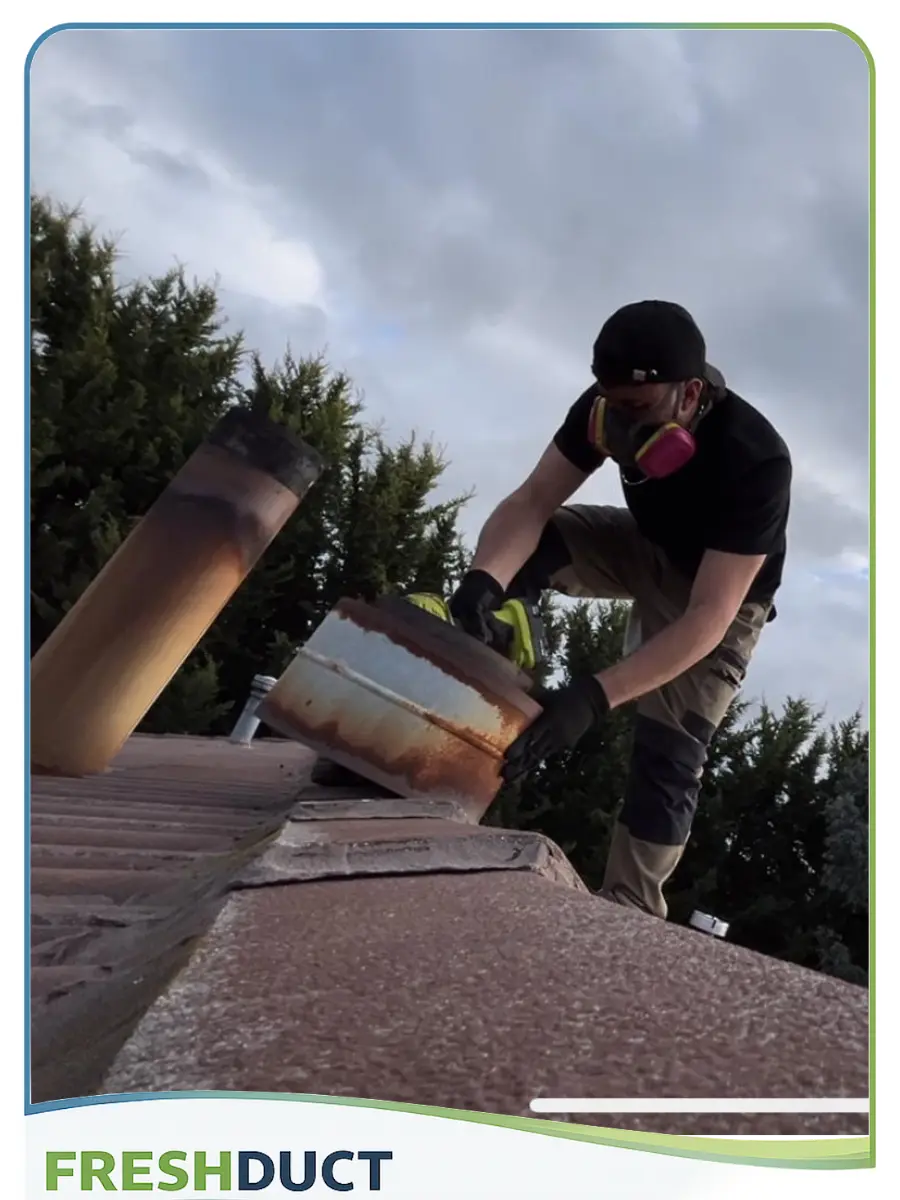
We measure the pot or flue terminal on site, choose a cap or cowl that suits both the opening and the draught of a post-war firebox, and fix it from the roof with harness work where the pitch calls for it.
The draw is tested with the cap in place and a photo of the finished terminal comes with the job, so a Clayton owner or agent can see it is sealed without going up a ladder.
Documented end to end — every job, every suburb.
Flue size, terminal type and roof access checked.
The right cap or cowl for the appliance and the problem.
Firm price before any work.
Fixed and sealed from the roof, safely.
Draw checked with the cap on.
A photo of the finished cap from the roof.
Verified 5-star reviews from across FreshDuct’s duct, heating, cooling and chimney services.
“Allen provided exceptional service — friendly, professional and went above and beyond.”
Verified
“Highly impressed with the professionalism and efficiency. On time, and no mess left behind.”
Verified
“Exceeded my expectations. Knowledgeable, meticulous and respectful of our home.”
Verified
“So glad I chose FreshDuct. Knowledgeable team and the whole process was smooth from start to finish.”
Verified
“Quick, efficient and professional — we could immediately feel the difference.”
Verified
“The technician arrived on time and was incredibly thorough — the difference at home is obvious.”
Verified
The same local team covers the suburbs around Clayton. Explore nearby areas and related FreshDuct chimney services.
Not if it is sized properly. Post-war Clayton flues have little draught to spare, so we fit a cap with enough free area for the flue and test the draw with it on. A cap that is too restrictive is the one thing we avoid on these chimneys.
A cowl sized to the steel flue, not a cap on the brick. On a veneer chimney the brick is a skin and the metal flue does the work, so the terminal has to clip to the flue diameter and vent as designed. We identify the flue on the roof, fit the matching cowl and test the draw.
An open flue lets rain, leaves and birds straight in. A cap keeps the flue dry, keeps nests out and, on a wood heater, a spark arrestor stops embers leaving the flue.
Usually a downdraught — wind pushing back down the flue. An anti-downdraught cowl is the normal fix; we confirm the draw with a test before and after.
Yes. If we are on the roof for a sweep and the flue needs a cap, we can quote it on the spot and fit it the same visit where we have the right size.
Send your details and the office confirms a window for Clayton. No call-out fee, before and after photos, and honest advice on what your chimney needs and what it does not.