 FreshDuct
It is one of the more reliable calls of a Melbourne spring. The split system ran all winter without a drop, the first genuinely warm afternoon arrives, someone switches it to cool, and within the hour there is water running down the wall under the indoor unit or dripping onto the carpet. The unit has not broken. It has changed mode, and in doing so it has found a problem that has been sitting quietly in the drain since autumn.
Quick answer: Cooling mode makes water and heating mode does not, so the first warm day of spring is the first time in months the indoor unit’s drain has had to carry anything. If the drain hose, its outside outlet or the tray under the coil has blocked up since autumn, the water has nowhere to go and runs out of the front of the unit instead. It is almost always a drainage problem, and clearing the tray and line is what stops it.
The good news is that the cause is usually simple, the fix is usually cleaning rather than repair, and spring is the right time to deal with it, before the long hot afternoons when the unit will be producing water for hours at a stretch.
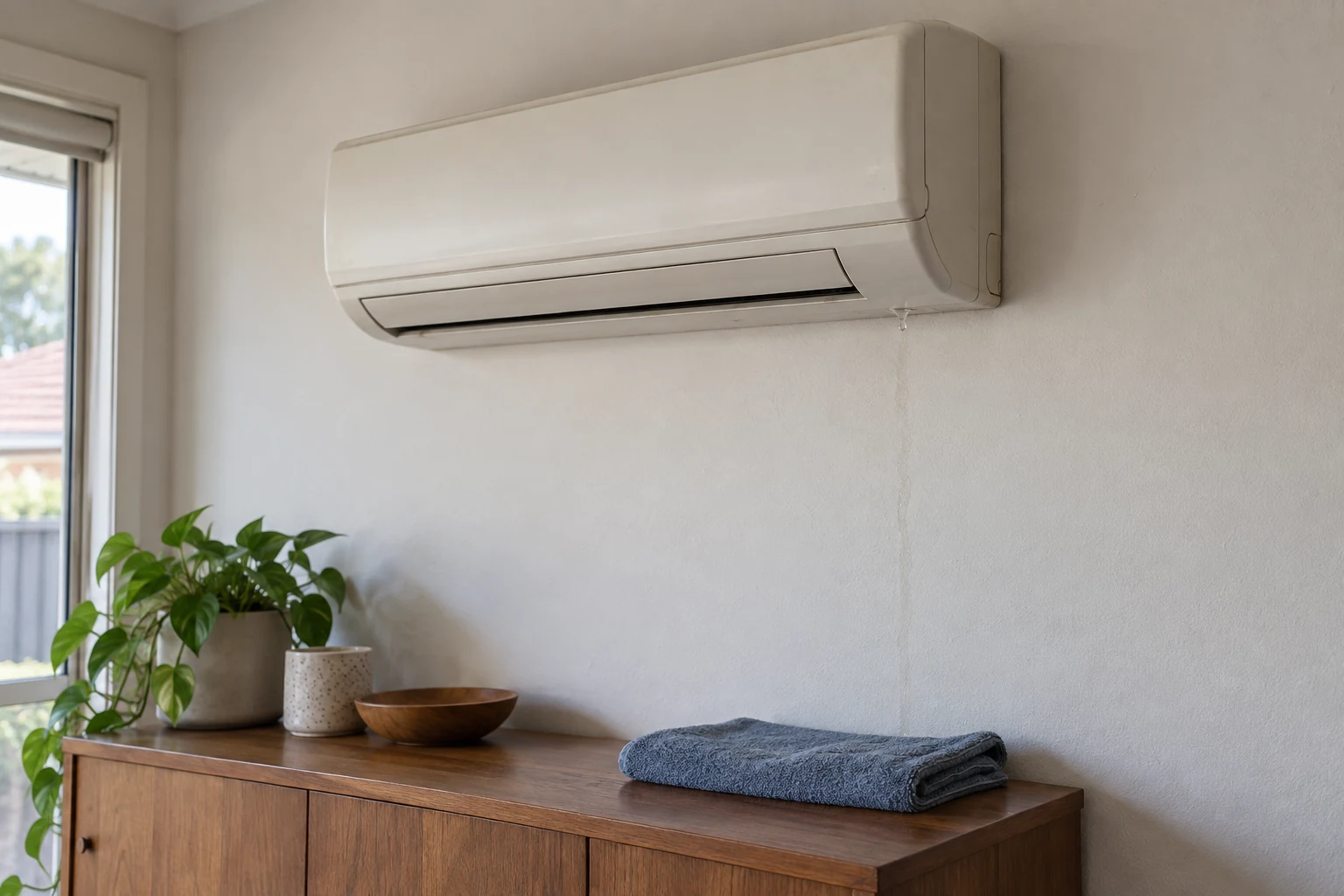
Why it starts on the first warm day
A split system in cooling mode pulls warm room air across a cold coil inside the indoor unit. When warm, moist air meets a cold surface, the moisture comes out of it as water, the same way it beads on a cold drink. That is part of what makes a cooled room feel comfortable: the unit is taking humidity out as well as heat. On a warm, muggy day that adds up to a steady trickle.
In heating mode the process runs the other way. The indoor coil is hot and the water forms on the outdoor unit instead, which is why you may see the outdoor unit dripping or steaming on a cold morning. The indoor drain has nothing to carry. So after a winter of heating, the drain tray and hose have sat dry for months, and whatever was left in them at the end of last summer has had all that time to dry, harden and collect more.
Where the water is meant to go
Under the coil in the indoor unit is a shallow drain tray. Water drips off the coil fins into the tray, and the tray drains through an outlet at one end into a flexible drain hose. That hose runs out through the wall alongside the refrigerant pipes, usually wrapped in the same insulation, and then has to fall all the way to where it discharges: a garden bed, a drain, a downpipe or a tundish. On some installations where a natural fall is not possible, a small pump lifts the water instead.
The whole thing works by gravity and by nothing getting in the way. There is no pressure pushing the water out. That is why a surprisingly small obstruction is enough to stop it, and why the water, once it cannot get down the hose, backs up in the tray until it spills over the front edge and out of the bottom of the unit.
The usual reasons it ends up on the wall
The most common is a blocked drain line. Dust drawn through the unit gets wet on the coil and washes into the tray, and over a season it forms a slimy film. Left to dry over winter, that film sets in the tray outlet and the first part of the hose, and the first run of water in spring cannot get past it.
The second is the outside end of the hose. An open hose end is an inviting place for spiders, insects and mud wasps, and months without water running through it gives them time to settle in. Hose ends that finish in a garden bed also get buried under mulch, soil or a growing plant. Either way the water cannot get out at the bottom, so it backs up to the top.
The tray itself can be the problem even when the hose is clear. A tray coated in dust and slime drains slowly, and on a humid day more water arrives than can leave. Sagging, flattened or kinked hose does the same job from the outside: every section has to run downhill, and a dip that holds water or a kink behind a cabinet will stop the flow.
Two causes are not drainage at all. A clogged filter restricts the air across the coil, the coil gets too cold and ices up, and when the ice melts the tray is flooded all at once. And an indoor unit that has been hung, or has shifted, so that it tilts away from the drain end sends its water to the wrong end of the tray.
What you can safely check yourself
Start with the unit off at the controller. Look at the filters behind the front panel, which lift out on almost every domestic split system; if they are grey and matted, wash them in lukewarm water, let them dry fully and refit them. That alone sorts out the iced-coil version of the problem.
Then go outside and find where the drain hose finishes. If it is buried, lift it clear. If there is an obvious plug of mud, a nest or debris in the end, remove it. If water starts to run as soon as you do, you have probably found the main cause, although the tray upstream is likely to be carrying the same build-up.
Look at the run of the hose where you can see it. It should fall steadily all the way, with no loops, sags or squashed sections. Finally, stand back from the indoor unit and look at whether it sits level on the wall. Anything beyond that means opening the unit, and that is where the home check should stop. The tray sits behind the coil, the unit is live unless it is isolated, and the coil fins bend at a touch.
What a split system clean does about it
A full clean deals with the whole drainage path as well as the parts people think of first. The unit is isolated, the covers and filters come off, and the coil is cleaned so that it is not shedding dust into the tray. The tray is cleared of slime and build-up, the outlet is opened, and the drain line is flushed through to the outside end so that water is proven to run freely from the tray to where it discharges. The fan barrel, which collects the same slime and is behind a lot of the musty smells people notice when they first switch to cooling, is cleaned at the same time.
The unit is then run in cooling mode long enough to make water, and the drain is watched to confirm it is carrying it away. A clean done in spring means the drain is clear before the unit spends every afternoon of summer making water, rather than after it has spent the first hot week running down the wall.
When it is not the drain
If the drainage has been cleared, the filters are clean and the unit still leaks, the cause is somewhere else. Ice on the pipes or the coil, a unit that cools poorly, or water appearing only after long periods of running can point to a refrigerant problem, which is work for a licensed refrigeration technician rather than a cleaner. Water appearing from the wall around the pipes rather than from the unit itself can mean condensation on poorly insulated pipework or a hose that has split inside the wall. A unit that has always leaked since the day it was installed may simply have a drain that was never given enough fall. In each of those cases the clean still helps, because it rules out the common causes and shows where the real one is.
Helpful FreshDuct services & guides
Frequently asked questions
Why did my split system only start leaking now when it ran all winter?
Because it was heating all winter, and in heating mode the indoor coil is hot, so no water condenses on it inside the house. The drain tray and hose sat dry for months while dust, biofilm and the residue of last summer set hard in them, and insects had time to move into the open end of the hose outside. The first time the unit cools, the coil starts producing water again and the drain is found to be blocked. The unit did not develop a fault over winter; the fault was simply invisible until the unit changed mode.
Is it safe to keep using a split system that is dripping?
It is best not to. Water running out of the front of the unit is running over the casing and past the electrical parts inside it, and down the wall below, which can damage plaster, paint, skirting and carpet and start mould in the wall. Turn the unit off at the controller, catch or wipe up what has already come out, and have a look at the outside end of the drain hose. If the water is coming from anywhere other than the drain side, or it keeps coming after the drain is cleared, leave the unit off and have it looked at.
Can I clear the drain hose myself?
The outside end, often yes: if the hose exits into a garden bed and is buried in mulch or soil, lifting it clear can be enough, and a visible insect nest or mud plug at the tip can be removed. Beyond that, forcing wire or high-pressure water up the hose risks splitting it or pushing the blockage further in, and the tray itself sits inside the indoor unit behind the coil, which means taking the unit apart. Power should always be off at the isolator before anyone opens an indoor unit. Cleaning the tray and line properly is part of a full split system clean.
Could the leak mean the unit needs regassing?
It can happen but it is not the usual reason. When a system is low on refrigerant, or the air across the coil is badly restricted by a dirty filter, the coil can get cold enough to ice up, and when that ice melts it can overwhelm the tray. Frost or ice on the pipes or coil, a unit that cools poorly, and a leak that comes and goes with long running times point in that direction. Refrigerant work is a job for a licensed refrigeration technician. A leak on a unit that is otherwise cooling well is far more likely to be the drain.
Get a fast, free quote
Talk to FreshDuct about hvac cleaning across Melbourne — 7 days a week, clear upfront pricing, 600+ 5-star reviews.